Showing posts with label RES. Show all posts

Saturday, July 24, 2010

Climate bill dead in the water; Next up, attack on EPA rules


(Photo of U.S. Capitol Building from Flickr and photographer wallyg)

You can kiss a climate bill goodbye, for 2010 and likely for the foreseeable future.

Senate Majority Leader Harry Reid (D-Nev.) has read the tea leaves and seen the time and the votes aren’t there. So instead he is offering a pitiful oil spill response and energy efficiency bill. He thinks he can get 60 votes for that, but others aren’t even sure.

Gone is a price on carbon. Gone is a renewable electricity standard (RES) of 15%, which was scorned by enviros as far too weak when it passed out of Jeff Bingaman’s (D-N.M.) energy committee a year ago. Now it looks pretty good.

Without a price on carbon and an RES, clean energy won’t have the impetus needed to make a dent in the fossil fuel monopoly.

Reid’s bill, to be unveiled Monday, is expected to include:
• A spill response eliminating or raising the $75M liability cap, probably to $10B, plus some rig safety rules.
• HomeStar energy-efficiency retrofitting.
• Natural gas truck incentives.
• Funds for land and water conservation.

Now it’s up to the EPA
The only silver lining in this disastrous thunder cloud is that the EPA can begin regulating large sources of emissions, and states can continue their own programs.

But a new study by the World Resource Institute says those would only cut greenhouse gases 14% by 2020, instead of the 17% expected in the Kerry-Lieberman bill and promised by Obama at the world meeting in Copenhagen.

Republicans, and some Democratic Senators, are hoping to handcuff the EPA’s ability to regulate emissions under the Clean Air Act. If they succeed, emissions would be cut just 6-9%, the study says. And there’s no way – without additional measures – to come close to the 80% reduction needed by 2050.

Dem Sen. Jay Rockefeller (W.Va.) has a bill, which Reid promised to bring up for a vote, which would delay EPA action for two years. (It’s not like we’re in any hurry here.) Six other Dems are co-sponsoring that bill. In case any of them are supposed to represent you, they are Dorgan and Conrad of N.D., McCaskill (Mo.) Webb (Va.), Johnson (S.C.) and Nelson (Neb.)

A companion bill in the House is likely to be blocked by Dem leadership. And there’s always an Obama veto. So in all likelihood the EPA will be able to proceed in January, requiring new plants to use the best available technology to cut GHG.

There’s a GOP energy bill too
Just in case you thought Reid’s bill is as low as we could go, Republicans will offer an energy bill of their own that focuses (of course) on offshore drilling, lifting the deepwater drilling moratorium for those that meet new inspection criteria, making 37.5% revenue sharing with states immediate rather than waiting till 2017, setting up a more industry-friendly liability program, and reorganizing the former Minerals Management Service.

Nothing here about energy efficiency or natural gas vehicles.

Who wins, who loses?
So, despite the catastrophic Gulf spill and the sweltering heat, which should remind us of what’s in store, Big Oil and Coal have handily won this round.

There are a lot of losers:

Too bad, House of Representatives, which passed a decent bill last summer, that will now die.

Too bad, Sens. Kerry and Lieberman, who spent much of the past year-and-a-half trying to gain support for a mild but comprehensive climate bill.

Too bad, corporations, that want some certainty about regulations in the future.

Too bad, environmental groups, for all the resources spent pleading our case.

Too bad, clean energy businesses that won’t get a level playing field.

And too bad, world, that is waiting for the United States to lead, or at least not to drag everyone else down.

Too bad, you and me and our children and grandchildren.

It’s really, really too bad.

(Sources: Greenwire, E&E Daily, E&E News PM, The Hill)

Wednesday, July 14, 2010

Reid goes for 4-part energy/climate bill by August recess

We may actually get an energy and climate bill in the Senate this summer. Majority Leader Harry Reid (D-Nev.) said floor debate will likely begin the week of July 26. And if the matter is not resolved, Senators are warned they may have to stay in Washington an extra week past the Aug. 6 adjournment date – something they don’t want to do.

Reid is expected to do his thing and cobble together a bill he thinks can get 60 votes.

He says it will have four parts:
• A Gulf spill response that will tighten regulations on offshore drilling.
• A clean energy/jobs section, quite likely in the form of a renewable electricity standard, with help for consumers
• A tax package
• A limit on pollution, including greenhouse gases, from utilities.

Whether the bill will, in the end, include a cap on GHG is still in question.

President Obama is sticking to his guns that the final bill needs a carbon cap, and many experts say without one if won’t do much to curb GHG emissions. Pundits have criticized him for being too quick to compromise in the past and perhaps he’s learned his lesson.

Working with Republican Snowe
At this point only one Republican, Olympia Snowe (R-Maine), supports the cap on carbon for utilities, and she is working with Jeff Bingaman (D-N.M.) on language to include limits on power plants starting in 2013. Power plants spew about one-third of the country’s greenhouse gas emissions.

Kerry and Lieberman also have scaled back their climate bill to cap utilities only, while Bingaman’s Energy and Natural Resources Committee gets set to mark up a bunch of bills Thursday, that would increase production of electric plug-in cars and trucks, increase R&D for natural gas and bump up incentives for nuclear and solar. The panel has already approved an RES and offshore drilling reforms.

No other Republicans have jumped onboard and several moderate Democrats are wavering.

House action
Meanwhile, in the House – which you may recall passed a comprehensive climate bill last summer – the Natural Resources Committee is looking to vote today on Chairman Nick Rahall’s (D-W.Va.) bill overhauling offshore drilling rules, which includes:
*Reorganizing the agency in charge of leasing, enforcing and revenue collection (something the Administration is already doing).
*Requiring a good blowout prevention and response plan.
*Mandating monthly inspection of rigs.
*Repealing some parts of the 2005 Energy Policy Act that gave royalty waivers to drillers.
*Ending a policy of exemptions from environmental review.

(Sources: Politico, E&E Daily, Senatus, The Hill, PM, PlanetArk)

Saturday, April 10, 2010

Wind power 39% of new energy installed here in 2009


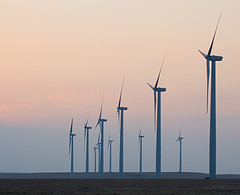
(Photo of wind turbines in Kansas from Flickr and photographer Brent Danley)

Wind energy provided 39% of the new power in the U.S. in 2009, but still represents only a tiny part of total energy – 1.8%.

Wind advocates are asking Congress for a renewable energy standard (RES) that will speed up the use of new forms of energy like wind and solar.

So says the U.S. Wind Energy Association Annual Market Report, released last week.

Some highlights:

• 10,000 megawatts of new generating capacity were installed in 2009, a record year. That’s enough to power 2.4 million homes.
• Texas leads with the most wind power, followed by Iowa, California, Washington, Oregon, Minnesota, Illinois, New York, Colorado and North Dakota.
• Iowa leads with percent of power generated by wind, at 14%.
• About 85,000 people are employed in the wind industry here.
• 36 states have utility-scale wind projects.
• 10 new manufacturing facilities came on line to build wind equipment, 20 were planned, and 9 expanded. There are now 200 manufacturing plants on line.
• Wind provides about half the renewable energy in the U.S., followed by biomass and geothermal. Solar only generates 1%.
• Offshore wind power is coming of age, with 7 projects planned.
• Use of wind power is conserving about 20 billion gallons of water annually, which would be needed for cooling in conventional power plants.

The utility using the most wind power is Xcel Energy. The largest wind power owner is NextEra Energy Resources. And GE is the top turbine supplier in the U.S., followed by Vestas (Denmark), Siemens (Germany) and Mitsubishi (Japan).

More highlights and charts can be downloaded from the AWEA Web site. If you want more than highlights, a full report will cost you $550 at the AWEA store. I didn’t think so. Then you’ll have to make do with highlights.

See an interactive map of wind projects by state. You can click on your state for more detail.

(Sources: Greenwire, American Wind Energy Association)

Sunday, August 09, 2009

Clean energy is on upswing in U.S., but we need much more to avert climate change


(Photo from Flickr and state of Washington DNR.)

Thanks to state mandates, stimulus money and a slumping economy, the use of dirty coal to produce electricity has dropped slightly in the past year to 46.1% and clean renewables gained traction to 11.1%.

The Energy Information Administration predicts wind will be the source of 5% of electricity in 2020 and all renewable energy will make up 14%.

Coal use fell since last year, while the nation used slightly more natural gas, a bit less oil, and more biomass. (High gasoline prices may have been a factor for oil.) Investment helped wind power grow, while nuclear plants had less downtime, according to a study from the Lawrence Livermore Lab. Hydroelectric grew the most, according to businessgreen.com.

States rights
While Congress struggles to get a meaningful renewable electricity standard (RES), many states – including in July coal state West Virginia – have passed mandates for use of some clean energy in generating electricity. Once again the states are leading in the fight against climate change while the feds lag behind. (This happened with cars, remember?)

Economic slowdown
Total electricity generation is down 5%, year over year, thanks in part to the slowing economy. Industrial production sagged 12.5% in that period, according to the Federal Reserve.

Stimulus funds
Clean energy is expected to benefit from the American Recovery and Reinvestment Act (stimulus) money. A revised forecast from EIA shows wind at more than twice the earlier-predicted level in 2012 because of stimulus – 201 billion kilowatt hours instead of 86B, compared with 53B in 2008. Geothermal will benefit as well, growing 16% more by 2013 than if there was no stimulus. Energy efficiency will also improve, with a weatherization program. But let’s not get too excited. The impact on CO2 emissions by 2013 will be slight – down just 1.3% from earlier predictions, because of the stimulus.

We still have a long, long way to go on clean energy. A stronger Senate climate bill would certainly help – one that phases out dirty coal plants while promoting more clean energy, which by-the-way could fill all our energy needs if the infrastructure was updated and the special interests could be silenced. I know: not going to happen.

But we can try. Everyone should contact his or her senators and ask them to work to phase out dirty coal and do more to promote clean energy.

(Sources: E&E Daily, climateprogress.org, Energy Information Administration, greenbusiness.com

Follow earthlingangst now on twitter.

Sunday, September 28, 2008

10 reasons why Obama is best on global warming


(Photo of Barack Obama by Peter Holderness/Medill News Service)

Weekly Angst: Saving the planet is taking a back seat to the financial crisis right now. But to many of us, climate change remains the top concern for the next president of the United States, because we’re running out of time to stop the catastrophic results of a warming planet. It’s getting so bad that Al Gore, a former vice president, is suggesting civil disobedience.

Unfortunately, when climate change does come up these days, it has morphed into talk about offshore drilling and achieving independence from foreign oil, which is the way John McCain has framed it. The maverick who championed climate change legislation with his buddy Joe Lieberman in 2003 and 2005 has, in this campaign, shifted from concern about greenhouse gases to concern about high gas prices and getting off foreign oil. That means American oil is just fine with him. In fact, the more the better.

The League of Conservation Voters, Sierra Club and Environment America, the three major environmental organizations that endorse candidates, all jumped on the Barack Obama bandwagon early on, because he so clearly will lead the nation to a better place on global warming. As Environment America said, McCain is not the right president to reverse 8 years of the anti-environment Bush Administration.

Talking points
Here are 10 top reasons why Obama is the better candidate on global warming:

1. Obama favors cutting greenhouse gases as much as scientists say we should. His goal is an 80% reduction (from 1990 levels) by 2050. He doesn’t try to second-guess science. McCain’s goal is 60%.
2. Obama has a much better voting record. On the League of Conservation Voters scorecard, Obama’s lifetime record is 86%. McCain’s is 24. During the last 2 years, McCain has missed every important environmental vote, including 2 on renewable energy where a yea vote from him could have made the difference. He deliberately missed all 8 tries to extend the renewable energy tax credits.
3. Obama favors an RES and subsidies for renewable energy. He has called for a renewable electricity standard of 25% by 2025 and for investing $150 billion in renewable energy. McCain opposes RES, as well as subsidies to alternative energies like solar and wind, preferring to let the market work unfettered. Though he seems to favor incentives for nuclear power.
4. Obama is much more cautious about nuclear power. He says it may need to be part of the mix, but safety and waste storage problems must be resolved first. McCain, on the other hand, makes nuclear power a major part of his energy portfolio, calling for 45 new nuclear plants by 2030, and 100 eventually.
5. Obama wants all credits in a cap-and-trade system to be auctioned. In other words, polluters must pay for their allowances. McCain says permits would eventually be auctioned, but should mostly be given free at first, and he favors polluters being able to bank or borrow credits based on the economy.
6. Obama wants to double the fuel efficiency of autos in 18 years. McCain, who missed the corporate average fuel economy (CAFE) vote of 2007, says he would enforce the new standard of 35 mpg by 2020 but isn’t looking to increase it. Obama voted for the CAFE bill.
7. Obama says offshore drilling will do little to help gasoline prices and was for the ban. He’s since softened his stance, saying he might accept some offshore drilling if it would help get other things he wants, like RES. McCain strongly favors drilling offshore, saying it will help solve the problems of high gas prices and dependence on foreign oil. After McCain announced this new position favoring offshore drilling, and became a cheerleader for the cause, campaign donations from oil and gas went up more than double, or by more than a million dollars.
8. Obama took a stand against a summer repeal of the gas tax, when McCain and Hillary Clinton called for one. Obama called it a gimmick that would not help lower prices.
9. Obama favors a windfall profits tax on big oil companies. He would like to see that money go to people who are struggling to pay for gas. McCain is against a windfall profits tax.
10. Obama picked Sen. Joe Biden as is running mate. Biden has an 83% lifetime score with LCV and proposed a bill in 1986 to deal with global warming. McCain picked Alaska Gov. Sarah Palin, who has expressed doubt about the human role in causing climate change, filed suit to de-list the polar bear as endangered, and favors drilling in ANWR.
For more on the candidates' environmental views, go to News21 Politics and the Environment, and click on Charging Up the Elections. News 21 is a summer project of Carnegie-Knight fellows at Northwestern University. (In the interest of full disclosure, I was one of the faculty members on the project.)

(Sources: League of Conservation Voters, Sierra Club, Environment America, barackobama.com, johnmccain.com, news21project.org, New York Times, salon.com)

Wednesday, March 19, 2008

Ask your rep to support global warming bills


(Photo of Capitol Building from Flickr and photographer Wally Gobetz)

Three global warming bills in the House of Representatives need your help. While your congressman is home on break (until March 30), call and ask him/her to co-sponsor these important bills:
• The Safe Climate Act (HR1590), Rep. Henry Waxman’s (D-Calif.) overall bill calling for 80% reduction in greenhouse gases by 2050 (or 2% a year), and telling the EPA to set up vehicle emissions regulations, a renewable electricity standard (RES) and market-based system to cap emissions. This bill is stronger than the Lieberman-Warner bill currently on the floor of the Senate.
• A renewable electricity standard of 20% by 2020 (HR969). This bill from Tom Udall (D-N.M.) and Todd Platts (R-Pa.) is similar to their 15% one passed by the House last year but then stripped from the Energy Bill by the Senate.
• The Right to Clean Vehicles Act (HR5560) introduced by Rep. Peter Welch (D-Vt.), which overturns the EPA’s waiver denial to California, which is keeping 13 states from enforcing their own tailpipe emissions standards. A companion bill in the Senate was introduced by Sen. Barbara Boxer (D-Calif.). (Sierra Club)
Find your rep at The House Web site.

Sunday, March 02, 2008

Cars come in 'clean' and 'dirty'


(Photo of traffic on Lake Cook Road in Buffalo Grove, Ill., from Flickr and photographer Isipeoria)

Weekly Angst: It’s outrageous. Did you know auto manufacturers make two versions of each model. Some spew more smog-causing hydrocarbons and nitrogen oxide, more carbon monoxide and particulates than others. It all depends on what state you live in and whether it has adopted California’s clean-car regulations. If it hasn’t, you get the dirty kind.

Conn., Maine, Md., Mass., N.J., N.Y., Ore., Pa. R.I., Vt., and Wash. have all adopted the California law. They’ve seen a change in air quality. Ariz., Colo., Fla., Ill., Iowa, Minn., N.M. and Utah have it under consideration. And environmental groups are pushing those states to pass the law, even though the U.S. EPA has blocked the latest change, reducing CO2. (Another outrage.)

Many believe the EPA will be overruled by the courts, or a new administration, or the bill introduced by Senate Environment Committee Chair Barbara Boxer (D-Calif.), and states that adopt California’s law may soon be able to regulate greenhouse gases too, more stringently than the federal CAFE law allows.

The California standards cut greenhouse-gas tailpipe emissions 30% by 2016, though the EPA-forced lag may change that because it was supposed to start with the 2009 model.

The Sierra Club and other environmental groups are asking for e-mails or calls to your state reps to co-sponsor and support a clean car bill. In Illinois you can do that through the Environmental Law and Policy Center's action network.

Clean cars for Illinois
Illinois is No. 6 in emitting greenhouse gases in the U.S.A. Not a record you want to have. Education maybe, or employment, but not No. 6 in GHG. And transportation contributes about 28% of the global warming pollution in the state.

When Illinois passes a clean car bill, it might cause a tipping point, advocates say, benefiting the entire country. A populous state, with 9 million cars on the road, a victory here could lead to manufacturers deciding it no longer pays to make two versions and all their cars could become cleaner.

The bill in Illinois (H.B 3424) has passed out of committee with House Speaker Michael Madigan (D) as a co-sponsor. It requires 2011 models to meet the stricter emissions standards, which would reduce GHG an estimated 18% by 2020 and 27% by 2030.

Global Warming Solutions Act
The clean car bill is also part of a larger package called the Illinois Global Warming Solutions Act (S.B. 2220). A shell bill, with the details not yet revealed, the Solutions Act also will deal with power plants, efficiency and cap-and-trade. It contains major recommendations from the Illinois Climate Change Advisory Group, appointed by Gov. Rod Blagojevich (D), and helps meet goals of the Midwest Governors Conference. (Stay tuned for more on this package.)

RES already law
If you’re wondering about a renewable electricity standard for Illinois, one was already passed last year. Advocates took advantage of the electric utilities’ request for a rate hike and added in an RES that increases the proportion of renewable energy 2% a year until 2015 and then 1.5% until it reaches 25% in 2025. One caveat though – the changes have to stay within the rate cap set for the utility. Many other states have passed their own RES, which is good because while the U.S. House passed one mandating 15% by 2020, the Senate has rejected it. (Sources: Environment Illinois, Sierra Club, Environmental Law & Policy Center)

Wednesday, January 16, 2008

Dems put climate change high on agenda

Congressional round-up: Action on Global Warming is among the Democrats’ top three House goals for this election year, Majority Leader Steny Hoyer (D-Md.) said this week. It was listed along with the economy and national security/terrorism as main issues for Congress to address. (E&E Daily)

Dem leaders will try again for renewable energy incentives and a renewable electricity standard (RES) like the one that stalled in the Senate in December. The incentives are high priority because most expire at the end of the year and without them, the wind, solar and other clean-energy industries would falter. Last time wind incentives were allowed to lapse, it caused a downturn in business. It is unclear what vehicle might carry the incentives – possibly an economic stimulus package. (E&E Daily)

Auto industry champion Rep. John Dingell (D-Mich.) wants to exempt auto companies from the proposed cap-at-trade bill now in Congress, he told reporters at the Detroit Auto Show. The auto industry is doing its part to cut greenhouse gases under the Energy Bill passed in December, he said. CAFE standards in that bill will require cutting CO2 tailpipe emissions 40%, he said. Dingell, as chair of the House Energy Committee, will have a lot to say about the legislation. He also agreed with the EPA’s denial of a waiver to let California and 12 other states curb tailpipe emissions more than the federal law requires. (E&E Daily)

Sunday, December 09, 2007

Global Warming win short-lived

Weekly angst: The victory didn’t last very long. A comprehensive energy bill to curb Global Warming passed the House on a 235-181 vote Thursday afternoon. But by Friday morning, opponents had defeated a cloture motion in the Senate, and negotiations were under way to strip the bill of some of its main provisions in order to get the 60 votes needed for passage and have a prayer of getting the president’s signature.

Likely to survive are the 35 mpg corporate fuel economy (CAFE) standards and the biofuels section (though that may be changed). Most likely to go are the requirement for private power plants to get 15% (actually just 11%) of their power from renewable sources like wind, solar and biomass by 2022 and the shift of $21 billion in tax breaks from oil and gas to renewable energy development and efficiency.

But without those provisions, how the devil will we make the switch from fossil fuels to renewable energy quickly enough to prevent catastrophic warming? Big oil, coal and power plants won this round and we lost. The fossil fuel economy is barely dented.

The cloture vote, which showed the votes aren't there to prevent a filibuster, put most Democrats on the right side of the issue and most Republicans on the side of fossil fuels. There were some exceptions. GOP Sens. Olympia Snowe and Susan Collins (Maine), Norm Coleman (Minn.), Arlen Spector (Pa.), Gordon Smith (Ore.) and John Thune (S.D.) voted with the good guys. (Collins, Coleman and Smith have tough re-election campaigns against Democrats next year). And Dems Evan Bayh (Ind.), Mary Landrieu (La.) and Richard Byrd (W.Va.) voted with the bad guys. If you live in any of their states, let them hear from you.

What was in the House bill
In addition to the 35 mpg CAFE standard for cars and light trucks combined in 2020, and the 15% RES for large investor-owned electric power plants (4 percentage points of which could come from buying offsets) the same year, the bill included:
• A nearly 5-fold increase in biofuels, to 36 billion gallons in 2022, with 21 billion from “advanced” (mostly cellulosic) fuels that cut GHG 50-60% (as opposed to corn, which cuts very little).
• A $21 billion tax package with $13 in new taxes (or eliminated tax breaks) for oil and gas, and incentives for energy efficiency in buildings, appliances, furnaces and lighting, renewable energy sources and plug-in hybrid cars.
• Increased testing of carbon capture and sequestration, the main hope for “clean” coal.
House Speaker Nancy Pelosi (D-Calif.) was credited with tough negotiations (mainly with fellow Democrats) to get such a strong bill approved.

The importance of CAFE
The 35 mpg CAFE standard would cut oil consumption by 1.1 million barrels a day in 2020, or the equivalent of taking 28 million cars off the road. This is the first move to raise mileage standards since the oil crisis of the 1970s. In fact, by 1988, with the crisis behind us, the auto companies were building larger cars again and were allowed to meet a 27.5 mpg standard, not the scheduled 28.5. That, of course, didn’t include SUVs, which are classified as light trucks and have a 22 mpg standard. Why is CAFE politically acceptable this year? We can probably thank the lofty price of oil. People are ready to save money at the pump. And the auto industry and UAW were won over by concessions granted to their champion, House Energy Chair John Dingell (D -Mich.), in the form of flex-fuel credits and money to retool.

Efforts to salvage renewables and taxes
Sen. Energy Chair Jeff Bingaman (D-N.M.) and Sen. Max Baucus (D-Mont.) said Friday they would negotiate through the weekend in an effort to find some middle ground and salvage the RES and tax portions of the bill – at least partially. They need an additional 7 votes. While 20 states already have their own renewable electricity standards, the Southeast and some Midwest states are concerned they don’t have enough wind to meet the standard. One GOP Senator suggested a much smaller tax package might be OK’d. A chief opponent, the retiring and ill Sen. Pete Domenici (N.M.), ranking member of the Energy Committee, wants nuclear loan guarantees in the bill and reportedly prevailed on fellow Republicans to oppose the bill passed by the House.

Bush veto threat
A final concern, of course, is a presidential veto. Bush doesn’t like the $13 billion in oil and gas taxes or the renewable fuels provision. He wants to include coal-based transportation fuels (which release more CO2 than gasoline) and to pre-empt state laws on alternative fuels. Many in Congress would like to see CAFE standards and energy efficiency, at least, signed into law.

Next step
The aim is to come up with a bill that can pass the Senate with at least 60 votes, and has some chance of getting the president’s signature. Once passed by the Senate, it will have to go back to the House for a vote. Leadership wants to accomplish this before the planned Congressional recess on Dec. 22.
(Sources: PlanetArk, Greenwire, E&E News PM, The End of Nature by Bill McKibben)

Congressional round-up

Lieberman-Warner bill passed out of Boxer's committee

In another milestone this week, the Senate passed its first mandatory cap-and-trade bill out of Sen. Barbara Boxer’s (D-Calif.) Environment and Public Works Committee by an 11-8 vote. The compromise bill, which most environmentalists think is too weak, and opponents think is too strong, will now go to the floor for what promises to be a lively debate, though no one is saying when. The bill covers 80% of the economy, mandating 70% in GHG cuts by 2050. The vast majority of allowances would be given to industries that will be affected, with only a small portion auctioned. Fee credits will be phased out by 2031.

News in brief

Green economy will result in more jobs, studies say

The move from a fossil-fuel to a “green” economy will have a net worldwide job gain, according to a new UN report. In addition to “green collar” jobs, there will be construction, transportation, engineering, manufacturing and sustainable agriculture and forestry jobs, the report said. In Brazil, the ethanol business has created a half-million jobs, and in China 150,000 are employed in solar heating. The jobs will more than make up for layoffs in old fossil-fuel industries, showing a small net gain, the report said. A second study, by the American Solar Energy Society, estimates that in the U.S., policies favoring renewable energy sources and energy efficiency could produce 40 million new jobs and $4.5 trillion in new revenue by 2030. Most of the jobs, 32 million, would be in efficiency measures such as retrofitting buildings, while 8 million would be in the renewables sector, with solar, wind, ethanol and hydrogen cells seeing the most growth. (Source: Greenwire)

Tropical zones expanding as the Earth gets warmer
Tropical regions are pushing north and south toward the poles at a rate much faster than expected. In the past 25 years, they have moved 2.5 degrees latitude, or 140-330 miles, according to a study in the journal Nature Geoscience last week. Climate models had predicted it would take 100 years to move just 2 degrees. The expansion brings with it a shift in high-altitude wind and rain patterns, and affects agricultural zones and water availability. (Source: Greenwire)

Skiers, marchers, bikers protest against climate change
Protestors called attention to Global Warming Sunday in 50 cities around the world. In Berlin, a sculptor carved a polar bear in ice at the Brandenburg Gate. In Auckland, 350 formed “Climate SOS” by lying in the grass at a park. In Taipei, 1,500 marched with signs saying “No carbon dioxide.” In Manila, hundreds rallied with windmills on their heads. In Helsinki, 50 skied on asphalt streets saying, “Give us our snowy winters back.” And here in the U.S., 50 took a polar bear plunge into Walden Pond. (Source: Associated Press)

News from Bali

Climate scientists lose patience, plead for radical action

More than 215 leading climate scientists, some of whom have taken no stance up to now, petitioned the delegates at the Bali UN climate conference to halve global greenhouse gas emissions by 2050. The petitioners come from more than 2 dozen countries. “The science community is basically fed up,” one signer from Canada told the Associated Press.

Other headlines this first week of the Dec. 3-14 190-nation conference:
* Saving rainforests is a high priority but one about which there is disagreement. The conference is likely to launch pilot projects trying two approaches – trading on the carbon market and using a fund to compensate countries for stopping slash-and-born. Deforestation was not in the Kyoto Protocol but causes 20% of GHG worldwide. Many want it in the next international treaty.
* Carbon capture is not on the Bali agenda. The technology is still unproven and would cost about $1 billion per plant, though ultimately it may be the answer to low- or no-carbon use of coal. Perhaps carbon capture and storage will be part of future talks, Yvo de Boer, top UN climate official, told Reuters.
* The U.S. delegation continues to oppose mandatory cuts of GHG, and made light of the passage of the first cap-and-trade bill from committee onto the Senate floor last week. The National Environmental Trust blasted U.S. greed and waste, saying the country is responsible for 27.8% of cumulative Global Warming.
* Host country Indonesia planted millions of trees to offset the estimated 47,000 tons of carbon dioxide caused by the 12-day conference. The estimate includes air transport to and from Bali. Hosts also eliminated cars from the conference site and provided 200 bicycles for ministers to use if they didn’t want to walk. (Sources: PlanetArk, AP, India Times)

Xtreme weather watch

Rainfall and snowstorms are now more severe.
Since 1948, the number of intense storms has increased between 22-26% in the U.S., a new report from Environment America shows. New England and the mid-Atlantic states have been hit the worst. Mass., R.I., Vt., N.Y. and La. have all seen an increase of more than 50%. Climate scientists say this is consistent with Global Warming because warm air holds more moisture. For more, see http://environmentAmerica.org. (New York Times)

Did a cyclone just hit the Northwest? Heavy rain and hurricane-force winds of up to 129 mph hit Oregon and Washington in back-to-back storms last Sunday and Monday. In Bremerton, Wash., rainfall was recorded at 11.78 inches. The storms, which washed out roads, caused mudslides, and resulted in at least 5 deaths, were among the worst in memory. More than 100,000 people were without electricity. One Portland resident noted, “This was really a hurricane – or cyclone – and we never get those here.” (AP)

The cyclone that smacked low-lying Bangladesh last month left a huge humanitarian crisis, the UN said last week. Some 2 million residents need immediate help to save their lives. They need food, shelter, drinking water and sanitation. A total of 8.5 million were affected, more than a half-million homes were completely destroyed and 1.5 million livestock were wiped out. Cyclone Sidr hit with 155 mph winds and a 5-foot storm surge Nov. 15. International aid so far tops $143 million. (PlanetArk)

Take Action

In this season of packages and bags
and wrapping paper, think green. Carry one or more canvas or reusable bags with you to put your purchases in. Tell store clerks to keep their paper and plastic bags. Use recycled wrapping paper. And when possible re-use packaging that comes to you from online or catalog items.

Make a year-end donation to environmental groups that do research and fight the good fight for all of us – in Congress, statehouses, elections and courts. They include the Sierra Club, Natural Resources Defense Council, League of Conservation Voters, Environmental Defense, World Wildlife Federation and Union of Concerned Scientists. And that doesn’t exhaust the list, if you have another favorite. Without them, there would be little, if any, progress.