Showing posts with label geothermal. Show all posts

Saturday, August 07, 2010

Iceland a volcanic wonderland with all renewable energy


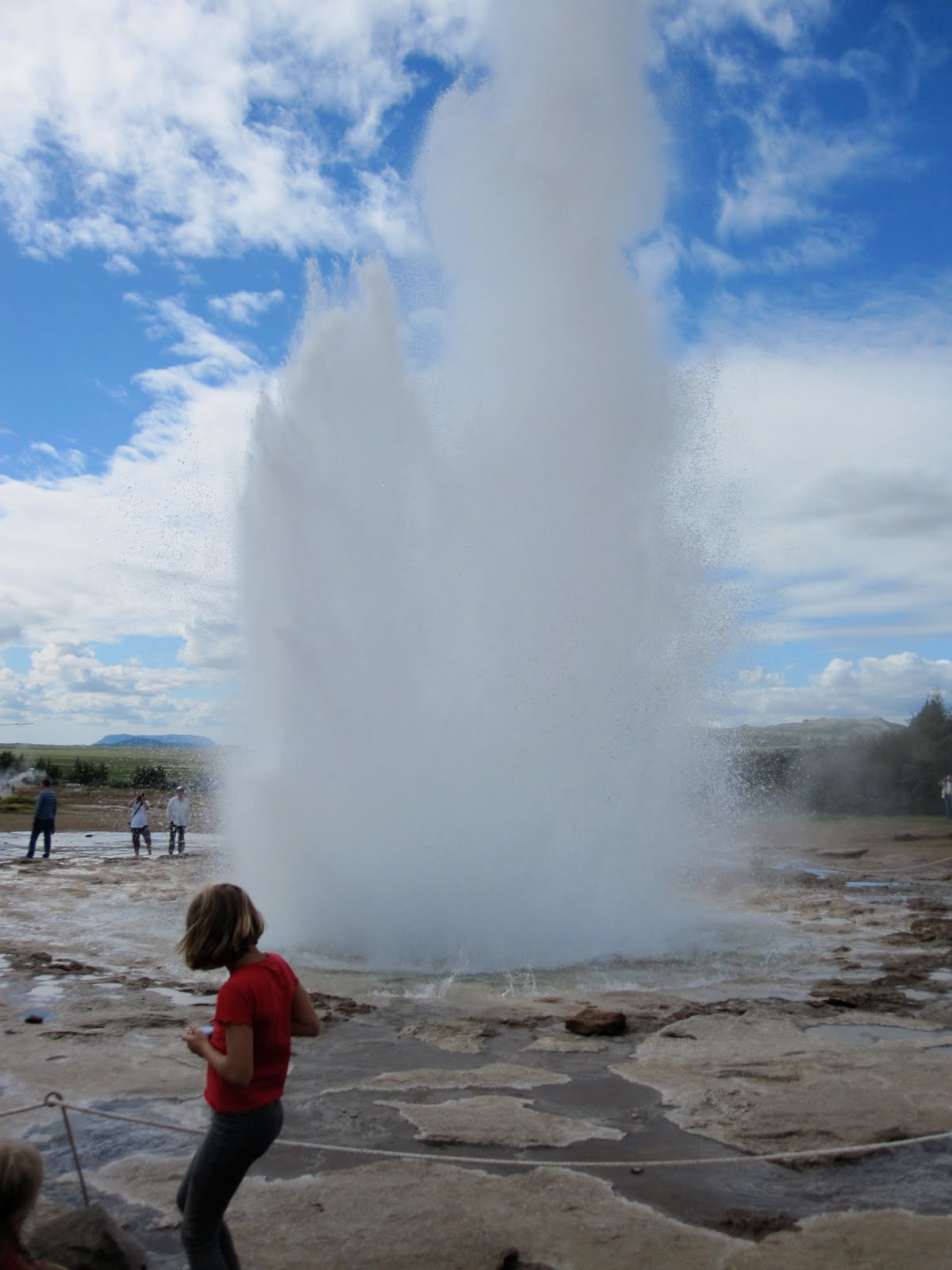
(Photo of Strokkurd geyser erupting, as it does every few minutes at Geysir Hot Springs Area in southern Iceland. Photo by Sabrina Linton)

I just got back from a trip to Iceland with my grandchildren Bryan and Sabrina. The pristine island nation is hauntingly beautiful in a volcano-y, geothermally, green-mossy sort of way. There's very little pollution. If all the world were like Iceland we wouldn’t have to worry about climate change.

Blessed with plenty of natural hydro and geothermal energy, the country derives virtually all of its electric power from renewable sources. It fuels 90% of its heating and 25% of its electricity with the geothermal power simmering below its surface and has 7 geothermal power plants, 6 of them currently operational. Hydroelectric power fuels the balance.

Iceland is in a race with France, Israel and others to change over to electric vehicles supported by a nationwide EV charging network. Northern Lights Energy Co. hopes to make Iceland the first country in the world to have a national electric charging grid, which is very possible because of the scarcity of roads. Iceland could service the entire island with 20 well-placed charging stations.

Iceland is also using hydrogen for power. There was a charging station at the harbor and the whale-watching boat we went on was powered by hydrogen.

The fruits and vegetables are mostly organic and livestock aren’t fed antibiotics, our guide told us. Much of what Icelanders eat comes out of the sea, with fishing as its main industry. (No runaway oil wells muddying the waters here.) Low-cost geothermal energy has led to a healthy greenhouse industry, where salad greens, tomatoes, bananas and such are grown indoors. We ate bananas there, assuming had been shipped a long, long way. Maybe not!

This tiny country with just over 300,000 people does have a huge advantage when it comes to pollution from power use. The don’t need much of it.

Of course there are disadvantages to living on a volcanic island. Eyjafjallajökull (I think I can finally pronounce it), the volcano that erupted several months ago, was lying dormant again – at least for now – but caused quite a bit of damage with its ash, which covered farms in the area, requiring evacuation of livestock. The real threat, however, is Vatnajökull, which in the past has followed its smaller sibling and would blow up Europe’s largest ice cap, likely causing deadly floods.

Iceland is one of the fastest growing tourist destinations in the world. Proximity of the Gulf Stream keeps it milder in winter than New York or Toronto. Yet in summer, despite its 24 hours of daylight, high temps are usually in the high 50s or low 60s. We had one warmer day, when it was unusually sunny and in the low 70s, nice enough to have dinner at a sidewalk café in Reykjavik. Another day when we went close to the huge Vatna glacier and rode in a boat among icebergs on a glacial lagoon, we nearly froze. But it was nice to beat the heat back home for a week!

(Sources: GEA International Market Report May 2010, Globetrotter Travel Guide to Iceland, The Daily Green, BBC)

Sunday, August 09, 2009

Clean energy is on upswing in U.S., but we need much more to avert climate change


(Photo from Flickr and state of Washington DNR.)

Thanks to state mandates, stimulus money and a slumping economy, the use of dirty coal to produce electricity has dropped slightly in the past year to 46.1% and clean renewables gained traction to 11.1%.

The Energy Information Administration predicts wind will be the source of 5% of electricity in 2020 and all renewable energy will make up 14%.

Coal use fell since last year, while the nation used slightly more natural gas, a bit less oil, and more biomass. (High gasoline prices may have been a factor for oil.) Investment helped wind power grow, while nuclear plants had less downtime, according to a study from the Lawrence Livermore Lab. Hydroelectric grew the most, according to businessgreen.com.

States rights
While Congress struggles to get a meaningful renewable electricity standard (RES), many states – including in July coal state West Virginia – have passed mandates for use of some clean energy in generating electricity. Once again the states are leading in the fight against climate change while the feds lag behind. (This happened with cars, remember?)

Economic slowdown
Total electricity generation is down 5%, year over year, thanks in part to the slowing economy. Industrial production sagged 12.5% in that period, according to the Federal Reserve.

Stimulus funds
Clean energy is expected to benefit from the American Recovery and Reinvestment Act (stimulus) money. A revised forecast from EIA shows wind at more than twice the earlier-predicted level in 2012 because of stimulus – 201 billion kilowatt hours instead of 86B, compared with 53B in 2008. Geothermal will benefit as well, growing 16% more by 2013 than if there was no stimulus. Energy efficiency will also improve, with a weatherization program. But let’s not get too excited. The impact on CO2 emissions by 2013 will be slight – down just 1.3% from earlier predictions, because of the stimulus.

We still have a long, long way to go on clean energy. A stronger Senate climate bill would certainly help – one that phases out dirty coal plants while promoting more clean energy, which by-the-way could fill all our energy needs if the infrastructure was updated and the special interests could be silenced. I know: not going to happen.

But we can try. Everyone should contact his or her senators and ask them to work to phase out dirty coal and do more to promote clean energy.

(Sources: E&E Daily, climateprogress.org, Energy Information Administration, greenbusiness.com

Follow earthlingangst now on twitter.

Thursday, October 09, 2008

Wind, solar and geothermal tax credits extended, but fossil fuels get incentives too


(Photo of wind farm in Texas from Flickr and photographer fieldsbh)

Washington Report: In case you missed it, the $700 billion bailout bill included renewable energy tax credit extensions, which just a week earlier had seem DOA for this session of Congress because the Senate and House couldn’t agree. It was the Senate version (the least desirable one) that was attached to the bailout. So we got good news and bad news: the good being that renewable energy companies can continue to grow – the bad being that coal, oil shale and tar sands got a break too. The $17 billion package of extensions included:
• 1 year of production tax credits for wind (the industry is already lobbying for longer-term extension of credits)
• 2 years of production tax credits for geothermal, biomass and other alternative sources.
• 8 years of investment tax credits of 30% for solar energy for homes and commercial properties and removal of the $2,000 cap (so an installation costing $30,000 would be reduced to $20,000).
• Biodiesel credits for the U.S. that put an end to Europeans shipping their product here to get the credit and then back again.
• New credits for plug-in electric hybrid vehicles of $2,500 to $7,500. The new Chevy Volt would qualify at the top level.
• New credits for wave and tidal energy projects.
• New employer tax credits to reimburse up to $20/month to those who use bicycles as their main commuter transportation
• New credits for refineries that process oil shale and tar sands.
• New credits for coal-fired plants that capture and store carbon dioxide, including pumping it into depleted oil fields to extract the remaining oil.
• Inclusion of coal-to-liquid fuel as an alternative fuel.
(Sources: Greenwire, E&E Daily)

Wednesday, September 24, 2008

GE, Google partner for ‘smart’ electricity grid


(Photo of electric grid from Flickr and photographer Mark , Sardella)

News Update: If you google “Google GE smart grid” you will find stories about a new agreement between Google and GE to develop a more advanced electricity grid. But I’ll save you the trouble and summarize here. Recognizing the grid hasn’t changed much since Thomas Edison built the first power plant, the two behemoths are combining their brain power and finances to develop an expanded grid that can support plug-in cars and renewable energy sources – and even help consumers who want to generate power and sell it to the grid. The CEOs of both companies agreed last week to lobby for a “21st century” grid that lets utilities and end users manage electricity more efficiently. An initial goal is to accommodate power from renewable sources that may be removed from the existing grid. The two partners also will develop enhanced geothermal systems, which can serve as a steady backup for intermittent sources like wind and solar. And they said they may look at co-financing wind or solar development in the future. (Source: Greenwire)

Friday, July 25, 2008

Senate may try again next week to extend renewable energy tax credits


(Photo of solar panels on Florida beach house from Flickr and photographer John Tracy)

Washington Report 2: Senate Finance Chair Max Baucus (D-Mont.) is likely to try one more time next week to get renewable energy tax incentives extended beyond December. In an effort to win a few more GOP votes, he has added some sweeteners to the tax package (which contains more than renewable credits). Additions include money for the highway trust fund, disaster relief and mental health parity, and an alternative minimum tax fix. Extending the credits for wind, solar, biomass, geothermal and efficiency are not at issue. Rather there is disagreement about how to pay for them. Congress leaves soon for its August break and Dem leaders would like to see the credits extended before then, to provide stability for clean energy businesses. (Source: E&E Daily)