ComEd parent Exelon, a big player in the nuclear power industry, is turning toward wind. The company said today it will buy John Deere renewables, which will make it one of the largest wind operators in the U.S.
Deere Renewables has 735MW operating and 230MW more in development in Michigan.
Meanwhile, Exelon has pulled back its application to license a two-unit nuclear plant in Texas because of lower demand due to a slumping economy.
Exelon is committed to cutting its CO2 emissions by 15M metric tons by 2020, which is more than its total output in 2001.
(Source: climateprogress.org, Green blog, NYT)
Showing posts with label wind power. Show all posts
Showing posts with label wind power. Show all posts
Wednesday, September 01, 2010


Saturday, April 10, 2010
Wind power 39% of new energy installed here in 2009
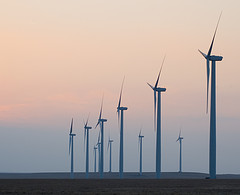
(Photo of wind turbines in Kansas from Flickr and photographer Brent Danley)
Wind energy provided 39% of the new power in the U.S. in 2009, but still represents only a tiny part of total energy – 1.8%.
Wind advocates are asking Congress for a renewable energy standard (RES) that will speed up the use of new forms of energy like wind and solar.
So says the U.S. Wind Energy Association Annual Market Report, released last week.
Some highlights:
• 10,000 megawatts of new generating capacity were installed in 2009, a record year. That’s enough to power 2.4 million homes.
• Texas leads with the most wind power, followed by Iowa, California, Washington, Oregon, Minnesota, Illinois, New York, Colorado and North Dakota.
• Iowa leads with percent of power generated by wind, at 14%.
• About 85,000 people are employed in the wind industry here.
• 36 states have utility-scale wind projects.
• 10 new manufacturing facilities came on line to build wind equipment, 20 were planned, and 9 expanded. There are now 200 manufacturing plants on line.
• Wind provides about half the renewable energy in the U.S., followed by biomass and geothermal. Solar only generates 1%.
• Offshore wind power is coming of age, with 7 projects planned.
• Use of wind power is conserving about 20 billion gallons of water annually, which would be needed for cooling in conventional power plants.
The utility using the most wind power is Xcel Energy. The largest wind power owner is NextEra Energy Resources. And GE is the top turbine supplier in the U.S., followed by Vestas (Denmark), Siemens (Germany) and Mitsubishi (Japan).
More highlights and charts can be downloaded from the AWEA Web site. If you want more than highlights, a full report will cost you $550 at the AWEA store. I didn’t think so. Then you’ll have to make do with highlights.
See an interactive map of wind projects by state. You can click on your state for more detail.
(Sources: Greenwire, American Wind Energy Association)
Sunday, March 21, 2010
29 governors ask feds to help increase wind power

(Photo of wind turbine from Flickr and photographer Caveman/Chuck Coker.)
Governors of more than half the states have recognized the potential of wind as a source of power.
As members of the Governors' Wind Energy Coalition , they are asking Congress and the Obama Administration for a national renewable energy standard (RES) and improved electrical grid that will enable wind to provide 20% of our power by 2030. Wind now makes up just 2%.
Among their asks are wind tax credits to be extended 5 years and $500 million to be allocated to research on offshore wind.
Is your governor in this association?
Read the group’s recommendations and see the list of members at the end.
(Sources: Environmental News Service and E&E News PM)
Sunday, August 09, 2009
Clean energy is on upswing in U.S., but we need much more to avert climate change

(Photo from Flickr and state of Washington DNR.)
Thanks to state mandates, stimulus money and a slumping economy, the use of dirty coal to produce electricity has dropped slightly in the past year to 46.1% and clean renewables gained traction to 11.1%.
The Energy Information Administration predicts wind will be the source of 5% of electricity in 2020 and all renewable energy will make up 14%.
Coal use fell since last year, while the nation used slightly more natural gas, a bit less oil, and more biomass. (High gasoline prices may have been a factor for oil.) Investment helped wind power grow, while nuclear plants had less downtime, according to a study from the Lawrence Livermore Lab. Hydroelectric grew the most, according to businessgreen.com.
States rights
While Congress struggles to get a meaningful renewable electricity standard (RES), many states – including in July coal state West Virginia – have passed mandates for use of some clean energy in generating electricity. Once again the states are leading in the fight against climate change while the feds lag behind. (This happened with cars, remember?)
Economic slowdown
Total electricity generation is down 5%, year over year, thanks in part to the slowing economy. Industrial production sagged 12.5% in that period, according to the Federal Reserve.
Stimulus funds
Clean energy is expected to benefit from the American Recovery and Reinvestment Act (stimulus) money. A revised forecast from EIA shows wind at more than twice the earlier-predicted level in 2012 because of stimulus – 201 billion kilowatt hours instead of 86B, compared with 53B in 2008. Geothermal will benefit as well, growing 16% more by 2013 than if there was no stimulus. Energy efficiency will also improve, with a weatherization program. But let’s not get too excited. The impact on CO2 emissions by 2013 will be slight – down just 1.3% from earlier predictions, because of the stimulus.
We still have a long, long way to go on clean energy. A stronger Senate climate bill would certainly help – one that phases out dirty coal plants while promoting more clean energy, which by-the-way could fill all our energy needs if the infrastructure was updated and the special interests could be silenced. I know: not going to happen.
But we can try. Everyone should contact his or her senators and ask them to work to phase out dirty coal and do more to promote clean energy.
(Sources: E&E Daily, climateprogress.org, Energy Information Administration, greenbusiness.com
Follow earthlingangst now on twitter.
Saturday, September 06, 2008
Is natural gas the right solution to getting off oil? See EarthlingAngst's answer to Pickens' plan

(Photo of metro bus in Washington, D.C., running on natural gas from Flickr and photographer Kathy Doucette)
Weekly Angst: You’ve no doubt heard a lot about natural gas lately. There’s a rush to drill in shale and T. Boone Pickens’ much publicized plan recommends wind energy to power 20% of electricity plants, freeing up the natural gas that runs them and using that gas to replace some gasoline. His goal is to cut oil imports by a third in 10 years (and to make some money in the process). Sounds good, but it's not the answer to global warming.
Natural gas does have several advantages, as Pickens points out:
* It’s plentiful
* It’s cheaper than gasoline
* It’s cleaner than oil or coal
* And it’s American.
Natural gas now powers 20% of the nation’s electricity. It’s also used for cooking, heating and the chemical industry. And some motor vehicles are beginning to use compressed natural gas (CNG) as a fuel.
It’s plentiful
Natural gas production peaked here in 1973. Reserves began to dry up in the ‘90s, and production declined until 2005. By then new technology allowed horizontal drilling into shale, and there are plentiful shale gas reserves in 33 states. Some reports say there are enough in North America to last a century.
A rush to drill has ensued. Pennsylvania, for example, is on its way to issuing 7,000 gas and oil drilling permits this year. Louisiana just had a record natural gas lease sale of $93.8 million. More than 4,400 miles of gas pipeline have been laid in the U.S. this year and Alaska Gov. Sarah Palin just signed a bill to award TransCanada Corp. a license to build and operate a gas pipeline to run from the North Slope to a hub in Canada. Most of the reserves on the North Slope are leased by BP, Exxon and ConocoPhillips. So the oil companies are hedging their bets with gas.
Price encourages drilling but it’s cheap for autos
Another incentive to drill was the rising price. In 1999 natural gas was less than $2/thousand cubic feet. This summer it hit $13 before a sharp decline. Yet the end product, for automobiles, is much cheaper than gasoline derived from oil. In Utah, where compressed natural gas is plentiful and there is an infrastructure of filling stations, people with cars converted for CNG are paying less than $1 a gallon. To see prices and where CNG pumps are, go to cngprices.com.)
It emits less CO2
Natural gas emits 30% less carbon dioxide than gasoline, 23% less than diesel and 50% less than coal. It’s also more efficient than coal for power plants, as it loses less energy in the process.
It’s local
Nearly all (98%) of the natural gas used in the U.S. comes from North America. Very little needs to be imported, as long as supply here can keep up with demand.
The arguments against natural gas
Although natural gas is cleaner than oil and coal, it still emits 70% of the CO2 gasoline does and half what coal does. Pickens' plan, which shifts gas over to replace some oil but leaves most power plants running on coal is not going to get us to the needed reduction of greenhouse gases. And too much focus on natural gas will only delay progress in that direction.
Pickens touts natural gas as a “temporary” solution, a transition until everyone can drive electric cars in what he sees as 20-30 years. Well we're going to be driving plug-in cars way before that unless, of course, subsidies and infrastructure send auto companies in the direction of CNG instead of electric cars. And then we'll just be replacing oil with another -- though somewhat cleaner -- fossil fuel.
Some environmental leaders endorse Pickens' plan, in large part because it pushes a huge increase in wind power, from less than 2% to 20% in a decade. With "drill, baby, drill" ringing in our ears, that sounds like a pretty good program. Until you stop and think how close it will get us to our goal of stopping global warming. Not very. Not very at all.
EarthlingAngst’s plan
Pickens’ plan says nothing about solar energy, which is abundant in the West, or wave power or geothermal energy. Why not aim for 20% solar in 10 years as well? And instead of replacing natural gas, let wind, solar and geothermal replace the dirtier coal in producing electricity, and use cellulosic ethanol and electric cars or plug-in hybrids for transportation – and more mass transit. Also put a serious focus on efficiency. We waste as much energy as we use. Then perhaps we really could put a dent in both oil and coal in 10 years.
What a tragedy we have wasted so many crucial years arguing about this stuff. We need to take giant steps, not baby steps, to shift away from fossil fuels (not just foreign oil) to renewable energy sources, and we need an administration and Congress that realizes that.
Take action
Meanwhile, you can call your Senators and Congressman (212-224-3121) Tuesday during National Call-in Day and tell them to vote for renewable energy, green jobs and efficiency, not for more drilling. That’s the way to get more energy more quickly and help the economy and planet as well.
(Sources: ClimateWire, E&E Daily, E&E News PM, Greenwire, pickensplan.com, PlanetArk, American Gas Assn., New York Times)
Wednesday, July 23, 2008
Texas OKs transmission lines to take wind power to cities …

(Photo of transmission lines in Texas from Flickr and photographer S.J. Alexander)
News Update 3: The Texas Pubic Utility Commission last week OKd a plan to attract $5 billion in investment for new power lines to move 18,500 megawatts of electricity from windy West Texas to the state’s largest cities. The electricity carried would more than double the nation’s current wind power capability. Texas leads the nation in wind, with 5,000MW now, expected to grow to 9,000MW by year’s end. Customers could see a $4/month increase in their bills over the next several years, according to the consumer group Public Citizen. The increase in transmission lines addresses perhaps the biggest roadblock to wind power here. For more on that see the June 28 post on EarthlingAngst. (Source: PlanetArk, Greenwire, Huffington Post)
Tuesday, April 15, 2008
Etc.: Warming oceans, wind power, rental cars and other recent global warming news

(Photo of ocean from Flickr and Ibrahim Adeeb)
Warming in one-third of the nation’s oceans is 2-4 times greater than projected in last year’s IPCC report. Climate change, overfishing and pollution are endangering marine animals and fisheries, according to the UN. (PlanetArk)
Global wind power is up 27% from last year. Germany still leads, with 25% of the total, but the U.S. came in second, showing a 5,244 MW increase. Experts attribute the jump in U.S. wind power to federal tax credits and renewable electricity standards in half the states, which require a percent of electricity to be generated from renewable sources. Iowa leads among the states, with 5.5% of its power coming from wind. (Greenwire)
Enterprise Rent-A-Car opened 4 “green” branches in Atlanta because of consumer demand, with 60% of the cars being hybrids, the company said. The nation’s largest rental car agency will have 4,000 hybrids out of a total fleet of 1.1 million. Hertz says it will soon have 3,500 hybrids; Avis 2,500. (Greenwire)
Clean technology investment slumped the first quarter of this year for North America, Europe and Israel. Total investment of $1.25 billion was up 42% over the same quarter last year, but down for the second quarter in a row. The peak was $1.74 billion last summer. (Greenwire)
Subscribe to:
Posts (Atom)