Friday, February 29, 2008
1-minute Angst: high-speed trains
Summary for Feb. 25-29
Could high-speed trains work in the U.S. or is it too big? Railroad man Craig Burroughs says at 250 mph we could get from Chicago to LA in less than 10 hours. High-speed freight trains would take lots of heavy trucks off the roads, making highway expansion unnecessary and dramatically reducing expensive maintenance of truck-damaged roads.
House OKs renewable-energy tax credits, again, but Senate could balk at money coming from Big Oil. And White House threatens to veto. One hope: add it to budget reconciliation bill … McCain gets zero from League of Conservation Voters for 2007 non-votes.
Freight trains compete with trucks to carry Asian imports from ports, getting more investment … efficiency best way to cut energy demand, study says … nuke developers go to South despite excess capacity there.
Water supply for Southern California, in Lake Mead, could be gone by 2021, because of drought and reduced snowpack … Chile suffers worst drought in decades, while ocean water must be pumped to Andes.
For full text, see below.


Thursday, February 28, 2008
House OKs renewable energy tax credits

(Photo of windfarm from Flickr and photographer Alessandro Ronchi)
Congressional Round-up: The House voted 236-182 Wednesday to approve renewable energy tax credit extensions, funding them by eliminating tax breaks for 5 big oil companies. This is the fourth time they approved such a bill in the past year. Now comes the hard part. A similar bill has failed to get the 60 votes needed in the Senate to avoid a filibuster. That is likely again, though one tactic under discussion is to try to get some of the package included in the final budget reconciliation bill. The extensions are needed because current ones expire at the end of 2008, and already investment in renewables is slowing down. House Speaker Nancy Pelosi (D-Calif.) warned that a failure to extend the credits could cost the country 116,000 jobs. The Senate could bring up the bill as soon as next week. The House bill (H.R. 5351) provides:
• A 3-year extension on investment credits for wind, geothermal and other renewables.
• An 8-year extension of incentives for commercial solar energy and 6 years for residential, doubling the top credit for homeowners to $4,000.
• Incentives for plug-in hybrids, energy efficiency and installation of pumps for fuel with 85% ethanol.
The GOP and White House object to rescinding $13.6 billion in tax cuts for integrated oil companies. They say it will thwart exploration and raise prices for consumers. Dems said with oil over $100 a barrel, the 5 companies affected are making record profits and will lose less than 2% of those profits in the next 10 years. Call your Senators to approve this bill at (202)224-3121. Also, check to see how your Rep voted. (Sources: Washington Post, E&E Daily, E&E News PM, Sierra Club)
McCain nets zero on environment from Conservation Voters
Many see Sen. John McCain (R-Ariz.), the presumptive GOP nominee for president, as pro-environment. The League of Conservation Voters disagrees. McCain scored the lowest possible grade, a zero, on LCV’s 2007 Scorecard. Democratic contenders Sen. Hillary Clinton (D-N.Y.) came in at 73, and Sen. Barack Obama (D-Ill.) at 67. McCain, who introduced global warming legislation back before it was popular, has twice failed to show up for a vote on renewable tax credit extensions, where his vote could have made the difference. LCV says it’s a pattern and he missed all critical environmental votes last year. His lifetime score is 24. To see how your elected representatives scored, check the LCV scorecard. (Sources: Sierra Club, LCV)
Tuesday, February 26, 2008
Freight trains on a roll -- guess why?

(Photo of freight train in California from Flickr and photographer Michael Patrick)
News Update: Railroad companies are investing more in infrastructure, in large part to carry Asian imports from U.S. ports to major cities. Since 2000, some $10 million has gone into expanding and improving tracks, and buying locomotives, with another $12 million planned. With the high price of gasoline and concerns about carbon emissions, railroads are competing successfully with truckers because they use one-third less fuel. “We’re finally making money and can put it into infrastructure,” the CEO of Norfolk Southern said. No mention of high-speed rail, though. (Source: Greenwire)
New report touts efficiency as best way to cut energy demand
The most economical way to cut growing energy demand and reduce greenhouse gas emissions is to get more productivity from energy, says a report from the McKinsey Global Institute, released last week. Until now, the emphasis has been on increasing supply. The report “identified huge opportunities to reduce energy demand and carbon emissions through efficiency,” Diana Farrel, director of the Institute told Reuters. Squeezing waste out of industry and cars could cut the growth of demand in half from its current 2.2% a year. It would require an initial investment of $170 billion a year, but would pay for itself in savings, the report said. (Reuters PlanetArk)
Nuclear developers drawn to South, despite energy surplus there
Fifteen of the 21 filings for new reactors before the Nuclear Regulatory Commission are for sites in the south, despite the fact that many natural gas power plants there are idle much of the year. Attracted by the prospect of future growth, and possible state incentives above and beyond generous federal tax credits, the utilities are ignoring the fact that existing plants can meet the region’s needs for the next 20 years, critics say. There’s also the issue of cost overruns. Entergy’s Mississippi customers are still paying $12 a month for overruns at a 20-year-old plant. Utilities don’t like the high, and fluctuating, cost of natural gas, but the price of nuclear reactors has skyrocket 200% since 2000, according to Cambridge Energy Research Associates. (Source: PlanetArk)
Envirocab hybrid taxi company rolls out in Arlington, Va.
A taxi company that bills itself as “carbon negative” has started with 15 hybrid vehicles in the Washington, D.C., metro area. It will buy offsets from Carbonfund.com to counteract the emissions it does release -- and then some. The company aims to have 50 hybrid Priuses, Camrys, Escapes and Highlanders on the street by the end of March. The cabs will help Arlington County meet its goal of reducing GHG 10% by 2012. The county also bought Priuses for one-third of its fleet. (Source: Associated Press)
Etc.: Dirty tar sands crude is expected to raise global warming emissions from Midwest refineries 40% in the next decade … Colorado's Xcel Energy says it will double renewable energy by 2015 and close 2 coal-fired power plants … owners of gas-guzzlers will have to pay $50 to drive them into central London … a Dutch tax on fuel-inefficient cars would add a whopping $28,000 to the price of a Hummer … hunters and fishermen support the Lieberman-Warner cap-and-trade bill and other global warming proposals that give money for wildlife protection.
Global Warming erasing Lake Mead

(Photo of receding Lake Mead from Flickr and Roadsidepictures.)
Xtreme Weather Watch: Lake Mead, the man-made lake behind the Hoover Dam that supplies much of the water for Southern California, could totally dry up in the next 13 years, according to a researcher at the University of California at San Diego. That would affect some 30 million people in the region. For the past two decades there were signs of an impending problem, with less snow pack and lower levels in lakes and rivers as a result of climate change and overuse. After a 10-year drought the problem today is urgent, with a net deficit of 1 million acre feet of water a year. Researcher Tim Barnett says it is too late to prevent a crisis, so adaptation is the only answer here. Desalination plants on the coast and water conservation are the most likely solutions. Agriculture uses 75-80% of the water and is the No. 1 industry in California. (Newsweek)
Ocean water pumped up to Andes mines as rivers dry up
Mines high in the Andes of Peru and Chile are pumping water from the ocean because rivers are running dry. Chronic water shortages have become worse due to global warming and the melting of glaciers. The ocean water is desalinated and pumped 6,000-7,500 feet up, to furnish the metal mines and refineries on which the two countries’ economies depend. (PlanetArk)
Chile has worst drought in decades; officials give out water
In what some say is the worst drought in 80 years, wells are running dry in the south- central part of Chile, affecting 120,000 people, ruining crops and killing livestock. To avert disaster, the government has installed tanks and sends trucks once a week to fill them with water. Neighboring Bolivia, meanwhile, is inundated with rain. (PlanetArk)
Sunday, February 24, 2008
Q&A: Electric and high-speed trains

Craig Burroughs is a railroad man I met at a Sierra Club meeting. He touts trains as the solution to a lot of our global warming problem, and he knows what he’s talking about. Starting with the Rock Island Line after college, he spent most of his career developing short-line railroads. Now that he’s “retired,” he’s working with a nonprofit on what has been his dream since he was 9: a trans-world high-speed railroad. Much of the year he can be found in Anchorage planning a railroad from China to Canada, with a tunnel under the Bering Strait. In the fall he covers college football games for his online column, Red Zone. Last year he went to 79 games and a short time ago passed a career 1,000-mark. He’s put 800,000 miles on his Oldsmobile station wagon, but says he’d much rather take the train.
Q: You say trains should be electrified. How is that better than diesel?
A: It doesn’t have emissions. And the electricity could come from cleaner sources, like hydropower and (in Chicago) nuclear. A nationwide network of electrified trains would drastically reduce the need for expanding our highways.
Q: How does the U.S. compare with the rest of the world on electrified trains?
A: It’s just about at the bottom of the list. We have the smallest percentage of electric mainline rails of any industrialized country in the world. Japan is just about all electric. Germany and France went directly from steam to electric. They did it the intelligent way because they didn’t have General Motors telling them how to do things.
Q: Where do we have electrified trains in the U.S.?
A: We have high-speed electric trains in the Northeast Corridor, from Washington, through Baltimore and Philadelphia to New York.
Q: Are all high-speed trains electric?
A: Yes. In other countries they can go 180 mph, and 225 mph in France. There’s a new line under construction in Japan that will be able to go 250 mph.
Q: Would we need to lay new track for high-speed trains?
A: The Northeast Corridor is on tracks engineered and built in the 1800s, so those trains can only go 120 mph (still faster than Amtrak’s 79 in the rest of the country). New tracks would be needed for really high speeds.
Q: Why don’t we have more high-speed lines here in the U.S.?
A: They think you can only have them where cities are close. But Chicago and Milwaukee are only 90 miles apart. And Detroit, St. Louis and Indianapolis are all within striking distance. We should have high-speed rail there now, as an alternative to short-hop airlines and highways – both a major source of pollutants.
Q: What about the rest of the country? Is it too spread out?
A: A train going 250 mph could go from Chicago to LA in less than 10 hours, and from New York to LA in less than 15. You wouldn’t have to get there 2 hours early, and the ride would be smooth instead of bouncing up and down in the air currents. You could see the country instead of the tops of clouds.
Q: What about freight trains? Can they use the same tracks?
A: Yes, if they are built as high-speed trains. High-speed freight trains would take heavy trucks of the highway, eliminating most of the need for frequent, expensive highway maintenance.
Q: Where would the money come from?
A: If it were like the highway system, we could do it with taxes, instead of pouring the money down a rat hole in another country and killing people. We could save people instead; we’re killing 45,000 each year on the highways.
(Photo of high-speed train in Amsterdam from Flickr and photographer Mike Noestheden.)
To get involved, learn about the Midwest High Speed Rail Assn., which will link you to Save Chicago Transit.
To read about high-speed rail expansion in Europe, see the blog treehugger . For a PR video on California's plan for a high-speed system, see YouTube.
Friday, February 22, 2008
1-minute Angst: Bush priorities
Summary for Feb. 18-22
Bush 2009 budget: Coal spending up 25%, nuclear up 37%; renewables cut 30%. No extension for renewable tax credits due to expire this year. Without them, new renewable projects in trouble.
Britain sees signs of spring, has warmest Feb. 12 ever … Afghanistan so cold some lose limbs to frostbite, others sell children they can’t care for.
International Energy Agency calls U.S. “timid” about pursuing fuel economy and renewable energy. Our goal of 35 mph by 2020 pales beside EU’s 47 mph by 2012 … Abu Dhabi builds green city in desert … Plague re-emerges, thanks to Global Warming.
House re-introduces renewable tax credit extensions, something Senate rejected twice by 1 vote … Rep. Waxman fights power plants near national parks.
See below for full text.
Bush 2009 budget: Coal spending up 25%, nuclear up 37%; renewables cut 30%. No extension for renewable tax credits due to expire this year. Without them, new renewable projects in trouble.
Britain sees signs of spring, has warmest Feb. 12 ever … Afghanistan so cold some lose limbs to frostbite, others sell children they can’t care for.
International Energy Agency calls U.S. “timid” about pursuing fuel economy and renewable energy. Our goal of 35 mph by 2020 pales beside EU’s 47 mph by 2012 … Abu Dhabi builds green city in desert … Plague re-emerges, thanks to Global Warming.
House re-introduces renewable tax credit extensions, something Senate rejected twice by 1 vote … Rep. Waxman fights power plants near national parks.
See below for full text.
Wednesday, February 20, 2008
New renewable tax-credit bill in House
Congressional Round-up: The House last week introduced a bill to extend production tax credits, funded in part by the repeal of oil tax benefits. The credits are due to expire at the end of the year, causing uncertainty for renewable energy industries. This bill is very similar to the one passed last summer by the House, but stifled in the Senate by 1 vote. It’s questionable whether the bill could pass the Senate in its current form. It includes:
• Extension of credits for wind, biomass, geothermal, small hydroelectric, landfill gas and trash combustion facilities through 2011, with a cap of 35% of the cost after 2009,
• Extension of solar energy and fuel cell investment tax credits for eight years,
• An end to deduction eligibility for the 5 larges oil companies,
• A 6% cap on benefits for smaller oil companies,
• A new credit for plug-in hybrid cars,
• Extension of tax credits for domestically produced cellulosic ethanol and biodiesel,
• A request that the National Academy of Sciences analyze current science on the production of biofuels and the domestic impact of a dramatic increase.
Proposal would allow power plants near national parks
Rep. Henry Waxman, (D-Calif.), chair of the House Oversight Committee, has urged the EPA to reject a proposal that would make it easier to build power plants near national parks. Waxman told EPA Administrator Stephen Johnson the proposed change in the New Source Review rules would violate the Clean Air Act. He said EPA technical experts acknowledged the change would allow “significant degradation” of the air in parks and national wilderness areas. He gave Johnson until March 5 to say why he ignored the advice of his staff. (Source: E&E News PM)
e-mailbag: Bob R. of Chicago writes, “Despite his admitted support and even sponsorship of environmental legislation, [John] McCain has too many constraints related to his conservative perception of reality to lead the nation effectively against the onslaught of global warming.”
• Extension of credits for wind, biomass, geothermal, small hydroelectric, landfill gas and trash combustion facilities through 2011, with a cap of 35% of the cost after 2009,
• Extension of solar energy and fuel cell investment tax credits for eight years,
• An end to deduction eligibility for the 5 larges oil companies,
• A 6% cap on benefits for smaller oil companies,
• A new credit for plug-in hybrid cars,
• Extension of tax credits for domestically produced cellulosic ethanol and biodiesel,
• A request that the National Academy of Sciences analyze current science on the production of biofuels and the domestic impact of a dramatic increase.
Proposal would allow power plants near national parks
Rep. Henry Waxman, (D-Calif.), chair of the House Oversight Committee, has urged the EPA to reject a proposal that would make it easier to build power plants near national parks. Waxman told EPA Administrator Stephen Johnson the proposed change in the New Source Review rules would violate the Clean Air Act. He said EPA technical experts acknowledged the change would allow “significant degradation” of the air in parks and national wilderness areas. He gave Johnson until March 5 to say why he ignored the advice of his staff. (Source: E&E News PM)
e-mailbag: Bob R. of Chicago writes, “Despite his admitted support and even sponsorship of environmental legislation, [John] McCain has too many constraints related to his conservative perception of reality to lead the nation effectively against the onslaught of global warming.”
Monday, February 18, 2008
U.S. 'timid' on renewables, fuel economy

News Update: The International Energy Agency blasted the U.S. last week for being “too timid” about setting fuel-economy standards and encouraging the use of renewable energy. The CAFE standards of 35 mpg by 2020 passed in December falls way short of the European Union’s mandate of 47 mpg by 2012, the report said. Likewise, failure to approve a renewable electricity standard (RES) – which was blocked in the Senate – or even to extend tax credits for renewable energy – which failed there twice by 1 vote – is hurting investment in infrastructure. The disconnect between American’s energy, environmental and security goals leads to a high and growing dependence on fossil fuels, the report said. (Source: PlanetArk) (Photo of solar panels from Flickr by Marino Kojdanovski and Powerhouse Museum)
Environmental groups fight new coal-fired plants in court
Environmental organizations are going to court all over the country to stop construction of new coal plants. Emboldened by the Supreme Court ruling that CO2 is a pollutant and can be regulated, they are fighting new plants every step of the way – zoning, air and water permits -- as well as new coal railroads. They’ve managed to stop or delay 59 plants, but another 22 are under construction and the industry says 15 more are near approval. Coal accounts for about one-third of U.S. greenhouse gas emissions. More than 600 plants are now in operation and the Bush Administration predicts 60% growth in the next 20 years. Because coal plants last 50 years, new plants will contribute to GHG for years to come. (Source: Associated Press)
Abu Dhabi to build zero-carbon, zero-waste city in desert
Abu Dhabi, in the United Arab Emerites, will break ground this winter for a green city of 15,000 in the desert. The no-car city will have narrow streets, gasoline-free travel pods, and solar panels to shade pedestrians from the hot sun. All power will come from wind and solar. The first stage of construction will include a research institute for alternative energy, developed in partnership with MIT. Abu Dhabi has 90% of UAE’s oil reserve, but is looking to become a leader in clean energy. UAE’s per capita GHG emissions are the 3rd highest in the world, after Qatar and Kuwait. (Source: PlanetArk)
Fast-growing bamboo in demand for ‘green’ construction
Bamboo, which grows several feet a day and is 5x stronger than cement, is gaining favor as a “green” building material. Lighter than steel, bamboo is strong enough to use in roofs supporting 11 tons. There is plenty of it too, as it is grown indigenously on every continent but Europe and Antarctica. In some countries it is sparse and therefore costly, as well as being labor-intensive. But in developing equatorial countries these drawbacks do not apply. (Source: Greenwire)
Plague's resurgence may be due to Global Warming
The Plague, one of the deadliest diseases in history, has re-emerged in many places, including Zambia, Mozambique, Algeria and China, where it hadn’t been seen for decades, according to the World Health Organization. Several thousand cases are reported each year. A study published in a Norwegian Journal showed that cases were related to the number of rodents – which carry the disease – seen in winter, which depended on how warm the winter wass. (Source: Greenwire)
Etc.: Iraq signs Kyoto Protocol (and we don’t) … shipping CO2 emissions 3x higher than earlier estimates, and 4.5% of total released … nations quietly stake claim to Antarctic sea beds … Carbon neutral by 2030 is Norway goal … scientists, journalists and lawmakers set Science Debate for April 18, invite GOP and Dem candidates … insurers limit coverage for homes on East Coast … endangered species status sought for Pacific walrus, victim of Arctic melt and drilling.
Sunday, February 17, 2008
Britain shows early signs of spring

Xtreme Weather Watch: In reaction to unseasonably warm winter weather, signs of spring are showing up early in Britain. January temperatures averaged 41.5 degrees Fahrenheit, more than 3 degrees above average. February 12 was the warmest ever for that date, at 65 degrees. Butterflies and ladybugs are taking wing, and tadpoles are starting to hatch. The danger, according to the Woodland Trust, is that a cold snap may come before the real spring arrives. (PlanetArk)
(Photo of ladybug courtesy of Flickr and nutmeg66/Rachel)
Some have sold their children in Afghanistan because they weren’t able to care for them in the severe cold and snow that has plagued the country this winter. Others have had limbs amputated because of frostbite. The worst cold spell in decades has caused more than 750 deaths and damaged 40,000 homes. Snow has blocked roads and interrupted relief efforts and supplies. (PlanetArk)
Raleigh, N.C.’s, water supply is very low and may dry up by summer, as about half the state faces extreme drought. Other Southeast states are suffering the same conditions. (CNN)
Global climate change caused Bolivia’s disastrous flooding, the country’s prime minister said, and therefore the rich countries of the world should send aid. Rain-caused landslides ruptured water mains in the capitol, La Paz, and one city is surrounded by muddy water. The U.S. pledged $150,000 in aid. (AP)
Bush budget favors nuclear and coal

Weekly Angst: President Bush’s 2009 budget puts a priority on nuclear and coal, while cutting renewable energy and efficiency. No surprise here.
Coal funding is up 25%, and nuclear 37%, while renewables are down nearly 30%, said Senate Majority Leader Harry Reid (D-Nev.), who promised a fight in Congress.
The budget makes no mention of extending the tax credits for renewables due to expire at the end of the year. And the weatherization program for low-income residents is eliminated.
The Energy Department budget is up, but mainly for nukes and coal:
• $1.4B to promote nuclear power
• $1.1B to research technology to reduce GHG from coal plants
• $0.5B for the Yucca Mountain nuclear waste depository.
Solar R&D is cut about $12 million from last year, while wind technology is up $3 million. There’s an additional $10 million for geothermal development.
“We should stop propping up the nuclear industry and use this money to develop truly clean and cost-effective alternatives to fossil fuels,” Environment America said.
Other environmental cuts and increases include:
• Pacific Salmon Recovery cut in half,
• No money for the Greenhouse Gas Registry authorized by Congress,
• EPA budget cut $300 million,
• Fish & Wildlife cut $65M, including $3.6M for endangered species,
• Increase of $22M for oil and gas drilling on public lands, including the Alaska Arctic National Wildlife Refuge,
• $8.5M more for offshore oil and gas drilling; $1M increase for offshore renewable leases,
• $200M increase each for the environmental satellite program and National Weather Service.
The Senate and House will now each produce a budget, then reconcile them to create one budget to give the president. Reid did not rule out waiting till January to give the budget to the next president.
For more on the Bush budget and climate change see Hill Heat.
(Sources: E&E Daily, PlanetArk, Las Vegas Sun) (Photo of decommissioned Rancho Seco Nuclear Power Plant (1975-89) courtesy of Fickr and TahoeSunsets.)
Wednesday, February 06, 2008
Plan would rob trains to fund highways

Congressional round-up: Two Senators have objected to a Bush Administration plan to “borrow” money from mass transit to fund a deficit in the Transportation Department’s highway fund. Finance Chair Max Baucus (D-Mont.) and Transportation Appropriations Subcommittee Chair Patty Murray (D-Wash.) said they would not support the plan. The highway program has a shortfall of $3.2 billion, while mass transit is $4.4 billion in the black. One has to wonder why, when mass transit gets only 20% the money highways do, they aren’t spending that money on the transportation that can cut greenhouse gas emissions? Bush’s new budget seeks $42.7B for highways and just $8.4B for mass transit. (Sources: E&E Daily, E&E News PM) (Photo courtesy of Flickr and MarkyBon.)
Stimulus bill with clean-energy tax credits misses by 1 vote
A Senate vote to include energy tax-credit extensions in the economic stimulus package failed by 1 vote Wednesday night. Senators are trying to preserve the credits, which expire by year’s end, to maintain the momentum of clean-energy investment. All Democrats voted to consider the bill, as did Republicans Olympia Snowe and Susan Collins of Maine, Arlen Specter (Pa.), Gordon Smith (Ore.), Chuck Grassley (Iowa), Pete Domenici (N.M.), Elizabeth Dole (N.C.) and Norm Coleman (Minn.). Pesidential candidate John McCain (R-Ariz.) did not show up. 5 GOP Senators who had signed a letter supporting extension of the tax credits voted to oppose the bill. They were John Sununu (N.H.), Wayne Allard (Colo.), Sam Brownback (Kan.), John Thune (S.D.) and Lisa Murkowski (Alaska). This was the third time in 7 month Republican leadership blocked clean-energy tax incentives. The $5.7 billion package included:
* a 1-year extension of the production tax credit
* solar, fuel cell and microturbine investment credits
* high-efficiency appliance credits
* energy efficiency credits for new homes and home retrofits
* energy efficiency credits for commercial buildings.
Senate leadership will continue trying to extend the tax credits. This is a top priority for many Senators and for environmental groups. A tax bill including the credit extensions passed the House but failed in the Senate in December. (Sources: Sierra Club, E&E Daily, Grist)
For more on the tax credits, see a guest post on Grist by Josh Dorner of the Sierra Club.
Tuesday, February 05, 2008
Polar bears vs. Bush: the lawsuit

News update: Alaska natives and environmental groups filed suit last week to block the Interior Dept.’s Feb. 6 sale of oil and gas leases in 30 million acres of the Chukchi Sea, home to 10% of the world’s remaining polar bears. The bears are already threatened by the rapidly melting Arctic ice they use as a base for finding food. Several weeks ago the administration announced the delay of a decision about endangered-species status for the bears until after the oil lease sale. Then administration officials told a House hearing that oil exploration would not threaten the bears. This despite an earlier environmental impact study by scientists in their own department that said there’s a 33-51% chance of a major oil spill. “Polar bears do not do well with oil,” according Steven Armstrup of the U.S. Geological Survey. “Most likely it would be fatal.” (Sources: E&E Daily, E&E News PM, AP) (Photo courtesy of Flickr and photographer mape_s.)
Poll: 62% see warming as threat, but few take action
A poll of 11,000 Americans revealed that 62% of adults and 79% of children see global warming as a very serious problem. (23% of the adults were unsure.) And 57% of the adults and 74% of the kids said warming is a threat to all life on the planet. (27% of the adults were unsure, an option the kids apparently didn’t have.) Many support recycling, driving fuel-efficient cars and using less energy at home, but few are doing much about it. Democrats were 3 times as likely to see global warming as a danger, but only a little more likely to take action. The survey was conducted by George Mason University. Lead author Edward Maibach said there is growing fear about the topic but not enough information on what people can do. (Source: USA Today)
FutureGen out, smaller coal projects in – but when?
That didn’t last long. The feds pulled the plug last week on a $1.8 billion carbon-sequestration project, after Mattoon, Ill. was announced as the site in December. The huge demonstration project, planned since 2003, was to test whether carbon can be successfully captured and stored underground (forever) so that coal can be burned without emitting greenhouse gases. But what originally was to cost $1 billion grew to almost double that amount over the past 5 years.
The government says it will instead provide (less) money to create a much smaller pilot project and help new or existing coal plants add capture and sequestration. (Sources: PlanetArk, E&E PM)
UN says global warming could cost up to $20 trillion
Putting the world on a clean-energy trajectory and helping poor countries adapt to global warming could cost the world $15 trillion to $20 trillion over the next 20-25 years, a new UN report says. Now, the energy sector spends about $300 billion a year on new plants and other investment. (I’m struggling with the math here – too many zeroes.) The report is in preparation for a 2-day UN debate in mid-February on climate policy and adaptation. (Source: AP)
Etc.: Whole Foods trashes plastic bags … U.S. wind power up 45% in 2007 … Florida starts Green Lodging certification … Japan eyes network of offshore wind farms … high gas prices spur Americans to buy fuel-efficient cars … global carbon trade up 80% last year … ancient plants and moss exposed after 1,600 years in Arctic melt.
Monday, February 04, 2008
Snow blanketed Jerusalem last week
Xtreme Weather Watch: A rare winter storm shut roads and schools and brought cities to a grinding halt in the Middle East last week – though children enjoyed throwing snowballs and using makeshift sleds. The roads were empty at rush hour in Jerusalem, banks closed in Damascus, and torrential rain and hail pummeled Beirut. In Ramallah, some told reporters they had never seen snow before. Jerusalem sees it a couple of times a year, but it usually is light and melts right away. On Thursday there were several inches on the ground for the second day. (Agence France-Presse, New York Times, Daily Mail UK, Reuters)
Afghanistan suffered severe cold and snow in January, leaving more than 100 people and 35,000 cattle dead. As if they didn’t already have enough problems. Roads were blocked by avalanches and three regions were inaccessible to rescue workers for some time. (PlanetArk)
Strong winds pushed Lake Erie up 9 feet at Buffalo last week, then the lake sloshed back to its normal position. But it was enough to suggest what weird things could happen if our climate goes berserk. (New York Times)
eMailbag: John from Indiana writes: “We had another winter tornado in Evansville this week. That is the third since 2003. Never had one before.”
Comment: Skeptics say cold and blizzards fly in the face of global warming. It’s the extremes, stupid – both wet and dry, and hot and cold. Unusual record-breaking weather events are predicted for the future, and to some extent the future is already here.
Afghanistan suffered severe cold and snow in January, leaving more than 100 people and 35,000 cattle dead. As if they didn’t already have enough problems. Roads were blocked by avalanches and three regions were inaccessible to rescue workers for some time. (PlanetArk)
Strong winds pushed Lake Erie up 9 feet at Buffalo last week, then the lake sloshed back to its normal position. But it was enough to suggest what weird things could happen if our climate goes berserk. (New York Times)
eMailbag: John from Indiana writes: “We had another winter tornado in Evansville this week. That is the third since 2003. Never had one before.”
Comment: Skeptics say cold and blizzards fly in the face of global warming. It’s the extremes, stupid – both wet and dry, and hot and cold. Unusual record-breaking weather events are predicted for the future, and to some extent the future is already here.
Sunday, February 03, 2008
Tar sands oil disaster for planet

A top Canadian official has asked the U.S. to go slow in plans to cut greenhouse gas emissions. What’s THAT about?
It’s about the Alberta tar sands, and the desire to keep us buying their synthetic oil made by a filthy, messy process that:
• destroys thousands of miles of pristine forests and wetlands
• releases 3 times the carbon dioxide into the air as conventional oil
• digs up 2-4 tons of earth to produce each barrel of oil
• burns enough natural gas each day to heat a million homes
• takes 3 barrels of water from the shrinking Athabasca River for each barrel of oil
• generates 2 barrels of toxic waste for each barrel of oil, stored in holding lagoons so big they can be seen from space
• leaves the land spoiled instead of reclaiming it
• smells like rotten eggs.
Matthew Simmons, author of “Twilight in the Desert” calls the process “atrocious.” Al Gore says it’s “truly nuts.”
The tars sands are Canada’s fastest growing GHG emissions source and one reason it’s not meeting its Kyoto targets.
Show me the money
Why would anyone make such a mess to produce oil? Money, that’s why. Tar sands became economically viable in 2003. Investors are piling on ($52 billion with much more expected), and the Canadian government stands to make $51 billion in taxes by 2020, while Alberta province will get $44 billion. Not surprising they haven’t done an impact assessment.
And we’re the enabler because we’re buying almost all their exports, to the tune of $73 billion a year. Why? To reduce our reliance on Middle East oil. Canada is now our biggest supplier, at 16% of our total. They want to sell us much more, and together the countries plan to increase production 5-fold.
To make matters worse, refiners here at home are trying to expand to refine the stuff and build pipelines to bring it in. The Sierra Club and other environmental groups have fought permits in several states, including Ill., Ind. (remember the row with Chicago over the Whiting plant?), Michigan, Ohio and Wis.
The basics
Tars sands, re-branded “oil sands” by the industry, is also found in Venezuela. About 20% is near the surface and mined in open pits by giant equipment. The remainder is far underground and recovered by injecting steam into the earth to melt the tar (or bitumen) so it’s thin enough to pump up. Then impurities are removed in an energy-intensive process. The Canadian government wants to replace the natural gas that powers the operation with 20 nuclear reactors.
Alberta is sitting on the second largest reserves in the world, after Saudi Arabia. It is producing 1.25 million barrels a day from its tar sands, an amount expected to triple by 2016. China, another likely market, has invested in two companies there.
But tars sands are not the only source of “unconventional” or synthetic oil. Oil shale and coal-to-liquid are other means to make a dirtier form of oil that produces more GHG and could tear up OUR landscape.
Why even mess with this stuff, when there are cleaner forms of energy like wind, solar, geothermal and cellulosic ethanol. We should be investing in those, as well as cutting waste and driving electric cars. But we’d better get busy. Because tar sands are clearly on a tear.
Note: "Highway to Hell" is a compelling account of work at the large Ft. McMurray tar sands in northern Alberta in OnEarth magazine online.
For more on tar sands, see Climate Progress
(Sources: Washington Post, OnEarth, PlanetArk, Sierra Club, Natural Resources Defense Council, World Watch Institute, E&E Daily, E&E News PM, Tar Sands Watch/Cleveland Plain Dealer and Oil Sands Truth)
(Photo of the Alberta tar sands courtesy of Flickr and photographer Gord McKenna)
Thursday, January 31, 2008
Renewable tax credits in Senate stimulus bill
Congressional Round-up: A Senate version of the economic stimulus package, with the addition of green jobs and renewable tax credits, was approved 14-7 by the Finance Committee yesterday. It could go to the floor for a vote any time now, so call your Senators right way at (202)224-3121 and tell them to vote for it. The short-term extension of renewable tax credits is sorely needed because they are due to expire the end of this year. While about 30 Senators are pushing for multi-year extension of the tax credits, to assure investment continues to grow, Energy Chair Jeff Bingaman (D-N.M.) said this is a good start. Clean energy bonds are part of the bill, as well. The House version does not include renewable incentives. (E&E News PM, Sierra Club)
Boxer introduces bill to override EPA on California
Senate Environment Chair Barbara Boxer (D-Calif.) introduced a bill Wednesday to overturn the EPA’s refusal to grant California a waiver to enforce its tailpipe-emissions law. S. 2555 directs the EPA to grant the state’s request. Co-sponsors include Democratic Presidential Candidates Hillary Clinton and Barak Obama, as well as Sens. Benjamin Cardin (D-Md.), Susan Collins (R-Me.), Dianne Feinstein (D-Calif.), John Kerry (D-Mass.), Patrick Leahy (D-Vt.), Robert Menendez (D-N.J.), Bill Nelson (D-Fla.), Bernie Sanders (I-Vt.), Sheldon Whitehouse (R-R.I.), Chris Dodd (D-Conn.), Ted Kennedy (D-Mass.), Frank Lautenberg (D-N.J.), Joe Lieberman (I-Conn.), Barbara Mikulski (D-Md.) and Olympia Snowe (R-Me.) If your senators aren’t both on this list, call them right away at (202)224-3121 and urge them to sign on. So far, 17 states have either passed or are in the process of adopting it the California law, so they too are blocked by the EPA decision. (Sierra Club)
Big Coal runs ads in key primary campaign states
Elections: As state regulators and environmental groups object to new coal plants, an organization backed by the coal industry and electric utilities is responding by running a $3.5 million campaign in key primary and caucus states. Americans for Balanced Energy Choices spent $1.3 million in advertising in Iowa, Nevada and South Carolina to put coal in a more favorable light. The message is that coal can be clean, it is needed to meet the country's energy needs, and more plants should be built. The ads talk about low-sulfur coal, carbon sequestration and better environmental controls and sometimes are vague about carbon emissions versus other pollutants. (Washington Post, Greenwire)
Enviro groups give guidance on how to vote Super Tuesday
Who ya gonna vote for for state rep? It could make a big difference as we depend more heavily on state legislatures to push ahead on renewable electricity standards, clean car bills and carbon emissions targets, filling the void left by the feds. Get some guidance on them and congressional candidates from your local chapter of the League of Conservation Voters or Sierra Club, both of which endorse candidates. In Illinois, where many of my readers live, a journalism grad student at Northwestern’s Medill School, Josephine Lee, has written a story about the endorsements here, including a list of those who received both groups’ approval. Also you may want to check back to my post in early January to see presidential candidates' views. (see archives at right, click on last item on January list).
Boxer introduces bill to override EPA on California
Senate Environment Chair Barbara Boxer (D-Calif.) introduced a bill Wednesday to overturn the EPA’s refusal to grant California a waiver to enforce its tailpipe-emissions law. S. 2555 directs the EPA to grant the state’s request. Co-sponsors include Democratic Presidential Candidates Hillary Clinton and Barak Obama, as well as Sens. Benjamin Cardin (D-Md.), Susan Collins (R-Me.), Dianne Feinstein (D-Calif.), John Kerry (D-Mass.), Patrick Leahy (D-Vt.), Robert Menendez (D-N.J.), Bill Nelson (D-Fla.), Bernie Sanders (I-Vt.), Sheldon Whitehouse (R-R.I.), Chris Dodd (D-Conn.), Ted Kennedy (D-Mass.), Frank Lautenberg (D-N.J.), Joe Lieberman (I-Conn.), Barbara Mikulski (D-Md.) and Olympia Snowe (R-Me.) If your senators aren’t both on this list, call them right away at (202)224-3121 and urge them to sign on. So far, 17 states have either passed or are in the process of adopting it the California law, so they too are blocked by the EPA decision. (Sierra Club)
Big Coal runs ads in key primary campaign states
Elections: As state regulators and environmental groups object to new coal plants, an organization backed by the coal industry and electric utilities is responding by running a $3.5 million campaign in key primary and caucus states. Americans for Balanced Energy Choices spent $1.3 million in advertising in Iowa, Nevada and South Carolina to put coal in a more favorable light. The message is that coal can be clean, it is needed to meet the country's energy needs, and more plants should be built. The ads talk about low-sulfur coal, carbon sequestration and better environmental controls and sometimes are vague about carbon emissions versus other pollutants. (Washington Post, Greenwire)
Enviro groups give guidance on how to vote Super Tuesday
Who ya gonna vote for for state rep? It could make a big difference as we depend more heavily on state legislatures to push ahead on renewable electricity standards, clean car bills and carbon emissions targets, filling the void left by the feds. Get some guidance on them and congressional candidates from your local chapter of the League of Conservation Voters or Sierra Club, both of which endorse candidates. In Illinois, where many of my readers live, a journalism grad student at Northwestern’s Medill School, Josephine Lee, has written a story about the endorsements here, including a list of those who received both groups’ approval. Also you may want to check back to my post in early January to see presidential candidates' views. (see archives at right, click on last item on January list).
Tuesday, January 29, 2008
Under fire, utilities canceling coal plants

News Update: Because of regulatory uncertainty and opposition from environmental groups, electric utilities are backing away from plans to build new carbon-spewing coal-fired plants. Coal now powers about half our electricity and is the dirtiest form of power. Last year 53 plants were stopped or put off. Regulators denied permits in Washington and Kansas. TXU in Texas cancelled 8 of 11 planned plants as part of a purchase agreement. Xcel Energy in Colorado closed 2 coal plants and is substituting natural gas, wind, solar and nuclear, with a goal of cutting 10% of CO2 by 2015. And TVA is building a nuclear plant instead of coal in Tennessee. Still, some new coal plants are on track in states like Indiana, Mississippi and New Mexico. Environmental groups urge no more coal plants until there is a viable “clean coal” option. (Source: Associated Press)
Diesel-electric hybrid buses picking up in American cities
Only 2-3% of municipal buses on the road are hybrids, but 22% of bus orders were for hybrids, the 2007 survey by the American Public Transportation Assn. found. Washington, D.C., ordered 900, New York City 850, Philadelphia 480 and Minneapolis-St. Paul 300. The mostly diesel-electric hybrids are priced at least $100,000 above standard diesel buses. But fuel economy was measured 27% higher in Seattle and 34% higher in NYC, says the National Renewable Energy Laboratory. Federal money is available to pay for up to 90% of hybrid buses, compared with 80% for conventional buses, according to the non-profit Advanced Energy. Some smaller cities testing the buses include Ann Arbor, Mich., Asheville, N.C., and Evansville, Ind. (Sources: USA Today, Greenwire)
Now you can google ‘renewable energy R&D division’
Google has announced it will spend tens of millions of dollars this year and hundreds of millions during the next decade on clean energy, both for its own facilities and to create a niche in renewable R&D. Aware that $2.4 billion in venture capital went into the sector in 2007, Google is ready to throw its brainpower and creativity behind renewable energy, especially solar, wind and geothermal. Its goal is reduce use of coal in the U.S. It’s better to work on breakthroughs and help lower the cost of renewables to consumers than buy offsets for questionable projects, the company said. (Source: Greenwire)
Geothermal energy in U.S. will double with Western projects
When 86 geothermal projects in the American West are completed, geothermal capacity will more than double to 6,300 megawatts, enough to light 6 million home, according to the Geothermal Energy Assn. The projects are benefiting from a combination of state renewable electricity standards and federal production tax credits. The association pressed Congress to extend the tax credits, due to expire the end of this year. (E&E News PM)
Ultimate outsourcing – modules for hotels made in China
British budget hotel chain Travelodge is putting up what is says is the first recyclable hotel. The 120-room structure will be made from pre-built steel container-like crates shipped from China that are stacked and bolted together. In the future, the hotel chain would like the Chinese to decorate and furnish the rooms as well. This hotel can be disassembled and moved and could be a model for sporting events and festivals, Travelodge said. It takes 12 weeks to assemble and could be removed after the event is over. (Source: PlanetArk)
(Coal plant photo courtesy of Flickr and Bruno D. Rodriguez)
Monday, January 28, 2008
Extreme weather events were up in 2007
Xtreme Weather Watch: There was an increase in extreme weather events last year worldwide, mainly winds and floods, reflecting the threat posed by global warming, says the UN-backed Centre of Research on Disaster Epidemiology. Eight of the 10 worst disasters were in Asia, including Cyclone Sidr. Asia and West Africa are already having more severe and frequent floods, following predictions by the Intergovernmental Panel on Climate Change. Weather disasters cost $62.5 billion in damages in 2007, up from $34 billion the year before. About 200 million people were affected, half of them in China. (PlanetArk)
Southern California was slammed by 7 days of snow and rain last week, stranding thousands of motorists in a mountain pass and causing power outages, avalanches and at least 1 tornado. Nearly a foot of snow fell in the Los Padres National Forest, northwest of LA, in the first of 2 back-to-back storms. In the second storm, this weekend, 2-4 inches of rain fell, raising the risk of mudslides in areas denuded by last year’s wildfires. Last Thursday more rain fell in one day than in the entire year in many places, but officials said they did not think it would do much to relieve a severe water shortage. (MercuryNews.com, LA Times, AP, North County Times, PlanetArk)
Severe winter storms, the worst in decades, swept across southern China late last week, killing at least 50, leaving cities without electricity, and halting travel for hundreds of thousands, perhaps millions. A half-million migrant workers, hoping to get home for Chinese New Year, camped outside the train station in Guangzhou for days, before most gave up. Hunan province had its heaviest snow in half a century. and more was expected. The extreme winter weather has so far caused $3 billion in losses, officials said.(AP)
Devastating floods in Mozambique displaced tens of thousands of people, engulfed farms and destroyed bridges and roads. The heavy rains started earlier than predicted and, with water levels already high, floods could turn out to be more severe than in 2000-01, which was the worst in memory for the African country. Helicopters and boats rescued about 60,000, mostly from roofs and trees, as another 7,000 awaited rescue last week. (PlanetArk)
For more on climate change and weather, check out the Forecast Earth blog at the Weather Channel, Weather.com.
Southern California was slammed by 7 days of snow and rain last week, stranding thousands of motorists in a mountain pass and causing power outages, avalanches and at least 1 tornado. Nearly a foot of snow fell in the Los Padres National Forest, northwest of LA, in the first of 2 back-to-back storms. In the second storm, this weekend, 2-4 inches of rain fell, raising the risk of mudslides in areas denuded by last year’s wildfires. Last Thursday more rain fell in one day than in the entire year in many places, but officials said they did not think it would do much to relieve a severe water shortage. (MercuryNews.com, LA Times, AP, North County Times, PlanetArk)
Severe winter storms, the worst in decades, swept across southern China late last week, killing at least 50, leaving cities without electricity, and halting travel for hundreds of thousands, perhaps millions. A half-million migrant workers, hoping to get home for Chinese New Year, camped outside the train station in Guangzhou for days, before most gave up. Hunan province had its heaviest snow in half a century. and more was expected. The extreme winter weather has so far caused $3 billion in losses, officials said.(AP)
Devastating floods in Mozambique displaced tens of thousands of people, engulfed farms and destroyed bridges and roads. The heavy rains started earlier than predicted and, with water levels already high, floods could turn out to be more severe than in 2000-01, which was the worst in memory for the African country. Helicopters and boats rescued about 60,000, mostly from roofs and trees, as another 7,000 awaited rescue last week. (PlanetArk)
For more on climate change and weather, check out the Forecast Earth blog at the Weather Channel, Weather.com.
Sunday, January 27, 2008
Electric cars are just around the corner
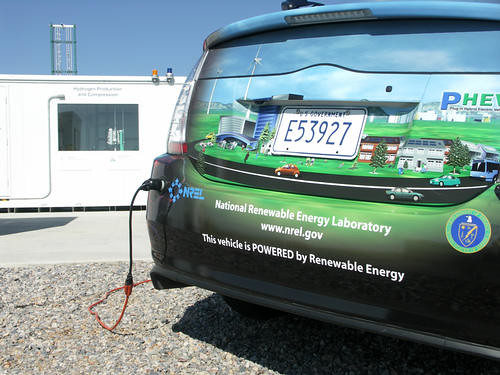
Weekly angst: Cars are here to stay. We’ll never get everyone on the train or bus. And as the world population grows, and poor countries get richer, there’ll be many more cars on the road. So the only way to seriously cut greenhouse gas tailpipe emissions is to change the way cars are built and powered.
A real break with the past requires electric cars, eventually powered by zero-carbon hydrogen. That’s several years in the future – maybe a decade. But electric cars, the plug-in variety with batteries you plug in at night, will start hitting the road very soon (a few are already there.) And when they do, you can bet competition will heat up. It’s already simmering.
Two leaders are Israel and, yes, China.
Israel said last week it will support a large-scale project to put electric cars on the road as early as next year. An Israeli-American entrepreneur, Shai Agassi, is working with Renault/Nissan to test such a car (and supporting infrastructure) in the tiny country, where gasoline costs more than $6 a gallon. He sees small European countries like Denmark, where gas taxes are high, as ideal places to market the cars. Small is good, because these cars can run some distance on electricity alone, before they need recharging or a gasoline engine to kick in.
The Israeli cars will be able to go 124 miles on a charge. Usually the batteries will be recharged at home at night, when electricity is cheapest. But service stations will be able to recharge or change out the batteries. The cars – from Renault and Nissan – will be subsidized, with a monthly fee for service. Operating costs are expected to be half that of a gasoline-powered car.
The prediction is that several thousand will be on the road next year, with 100,000 by the end of 2010. (In Israel, about 10% of the cars are replaced each year.)
The company sees this concept as a money-maker and is eyeing the Chinese market as well. Chinese auto company Chery apparently is interested.
China has plans of its own
Shanghai, which may well become the Detroit of the 21st century, has a program to experiment with a variety of clean technologies, according to “Zoom: The Global Race to Fuel the Car of the Future,” a new book by Iain Carson and Vijay Vaitheeswaran.
Gang Wan, head of the program, had worked at Audi and decided it didn’t make sense to try to catch up with foreigners’ head start on the combustion engine. Instead he is looking at electric, hybrid gasoline/diesel-electric, compressed natural gas and hydrogen fuel cells to power automobiles.
Hoping to have 1,000 clean cars and buses on the streets of Beijing for the Olympics, the project’s longer-range goal is for mass production of hydrogen fuel-cell cars by 2020. General Motors has signed on to help with both the fuel cells and the filling stations that will be needed.
China has many advantages in producing fuel cell technology, according to “Zoom.”
• It doesn't have the extensive investment in internal-combustion engines or the infrastructure of gas stations the West does, so there will be little resistance.
• Its giant dams produce enough excess hydropower to fuel 37 million cars by 2010 and 56 million by 2020.
• The potential market in China alone is huge.
• The government can mandate the changes.
Maybe you’ll drive one of these
Most auto companies have a plug-in in the works. A few will be ready in the next year or two. Here are a some examples:
• Chevrolet’s Volt is scheduled for a 2010 launch. GM will road-test it this year. The plug-in Volt goes 40 miles on a battery charge, with a gasoline engine as back-up.
• Toyoto says it too will build a plug-in hybrid by 2010, for use by governments and corporations. The general public will have to wait a bit longer. And Toyota is testing a fuel-cell car, which has traveled 350 miles on a tank in Japan. A newer version can go 466 miles, the company said.
• Fisker Automotive’s plug-in Karma is an $80,000 luxury car, which goes 50 miles before a small gasoline engine generates electricity to recharge it. Fisker says Karma is ready to be mass produced.
• Italy’s Pininfarina, aims for a 2009 launch of its small 4-seater electric car. It goes 155 miles before recharging and the company says it could produce up to 15,000 a year if the demand is there.
• Tata Motors in India is partnering with Chrysler to make an electric version of its mini-truck, Ace, for sale in the U.S. Tata is working with other foreign partners on hybrids and fuel cells. (Tata is the car-maker that just released a $2,500 car in India, putting car ownership within reach for millions.)
• Subaru’s G4e (Good4Earth) is a plug-in electric commuting car and can go 124 miles on an overnight charge. Quick-chargers, located at supermarkets and other public places, will give an 80% charge in 15 minutes. If the car is plugged in at night, the energy per mile could be 1/10th that of gasoline fueled cars.
• AFS Trinity has the Extreme Hybrid, a retrofitted Saturn Vue, which can go 40 miles on electricity and then on gas.
• General Motors is test-driving its Equinox fuel-cell cars in 3 cities. The car probably won’t reach mass production for 10 years, GM says.
Cutting GHG emissions
Switching to plug-ins could do a lot to help the environment. The Electric Power Research Institute and Natural Resources Defense Council say mass use of plug-in hybrids could cut greenhouse gases by more than 450 metric tons a year by 2050, the same as removing 82.5 million cars from the road.
But Honda CEO Takeo Fukui predicts the future for the auto industry is in fuel cells, which produce no carbon. He sees the plug-in hybrid as a battery-powered car with an unnecessary fuel engine and tank.
Fuel cells, which use hydrogen and oxygen to generate electric power, are 2-3 times more efficient than the internal combustion engine, according to the Society of Automotive Engineers. They have no moving parts and the only byproducts are heat and water. Of course, with new technologies, new companies can horn in on the majors' act.
And infrastructure is no small matter in the United States. About 12,000 of the country’s 170,000 filling stations will have to be converted to serve up hydrogen, GM says. No doubt there will be a lot of resistance.
For more on green autos, check out greenauto blog.
(Sources: “Zoom,” New York Times, E&E Daily, Greenwire, PlanetArk, AOL Auto, Chicago Sun-Times, Salon.com.
(Picture courtesy of Flickr and ourgreencommunity.org)
P.S. Debates silent on global warming
You may have noticed there have been virtually no questions about global warming in the presidential debates. The League of Conservation Voters and Sierra Club helped end the drought with petitions from 200,000 of us. Tim Russert asked the first climate change question in the last debate. In fact he asked two. Now it’s time to call CNN and tell Wolf Blitzer to ask about global warming in this Thursday’s debate. Call (404)827-1700.
Thursday, January 24, 2008
Rep. Dingell: Cap-and-trade unlikely this year
Congressional round-up: House Energy Chair John Dingell (D-Mich.) told E&E Daily this week that passing a global warming bill this election year is “on the verge of impossible.” With all House seats up, the election will be a “terrible distraction,” said the octogenarian, who will take the lead in drafting a House cap-and-trade bill. He indicated he is likely to include pre-emption of stronger state legislation. Rep. Rick Boucher (D-Va.) chair of the Energy and Air Quality subcommittee, said cap-and-trade will produce new jobs, spur new technology and produce a flood of exports. Ranking minority subcommittee member Rep. Fred Upton (R-Mich.), however, sees a loss of jobs and costs to the economy. (Source: E&E News PM)
Stimulus package not likely place for renewable credits
With the expiration of tax incentives looming for solar, wind and other renewable energy, trade groups and environmental organizations see an opportunity for inclusion in an economy stimulus package. But Senate Finance Chair Max Baucus said this week that is unlikely. He agrees the incentives need to be extended, or investment and renewable energy projects will slow down, but sees it in a separate package of bills. Senate Energy Chair Jeff Bingaman (D-N.M.) said the credits need to be extended soon, but that the stimulus package is not the best vehicle. (Source: E&E News PM)
Stimulus package not likely place for renewable credits
With the expiration of tax incentives looming for solar, wind and other renewable energy, trade groups and environmental organizations see an opportunity for inclusion in an economy stimulus package. But Senate Finance Chair Max Baucus said this week that is unlikely. He agrees the incentives need to be extended, or investment and renewable energy projects will slow down, but sees it in a separate package of bills. Senate Energy Chair Jeff Bingaman (D-N.M.) said the credits need to be extended soon, but that the stimulus package is not the best vehicle. (Source: E&E News PM)
Wednesday, January 23, 2008
Antarctic ice no longer safe
News update: Ice sheets in Antarctic, once thought to be unaffected by global warming, are melting at an increasingly rapid rate, says a study in Nature Geoscience. It was known ice was melting on a peninsula jutting toward South America, but not elsewhere on the huge ice cap that contains 90% of the world’s ice. A warming circumpolar current is thought to be causing the problem, as it eats away at the ice 200 yards below the ocean’s surface. The annual Antarctic ice loss, at 132 billion metric tons a year, is getting close to that in Greenland in scope, the researchers said The melting suggests sea levels could rise much higher than expected. East Antarctic has so far been unaffected and surface temperatures on the continent remain stable. (Source: Washington Post)
Western governors eye efficiency to avoid 100 new plants
The Western Governors Assn., made up of 19 states and 3 Pacific islands, is encouraging energy conservation in homes and commercial buildings to save 48,000 megawatts of power, 1.8 trillion gallons of water and $53 billion over 15 years. In a new report, they call for stronger building codes, separating utility sales from profit, and increasing incentives for energy efficiency. If the states adopt the recommendations, the need for new power could be cut 75% in 15 years, the equivalent of 100 power plants. (Source: Greenwire)
Germany leads world in renewable energy growth
Renewable sources provided 14% of power consumed in Germany in 2007, up from a little under 12% in 2006. Wind was responsible for much of the increase, the German Renewable Energy Federation said last week. But plans to reduce government support may slow growth in the future, as happened with biofuels last year. (Source: PlanetArk)
UK to build five towns that have zero carbon emissions
Britain plans five carbon-neutral “eco-towns” of 5,000-20,000 homes, that will be powered by wind or solar and designed to minimize car and water use. By 2016, all of Britain’s new homes will have to be carbon neutral. (Sierra magazine)
Mini-cities in Florida, New York have common green destiny
Developers are building two sustainable cities outside Disney World in Florida and Syracuse, N.Y. Both named “Destiny,” the cities aim for LEED certification from the U.S. Green Buildings Council. In N.Y., plans include a renewable energy plant, horizontal elevators to take people around the car-less city and a monorail to the Syracuse airport and downtown. In Florida, on the cite of the old Yeehaw Junction (maybe you’ve seen the turnpike signs), plans include an eco-industrial park for clean-energy businesses, canals and lakes for drainage, solar panels and a reservoir to catch rainwater. Jobs close to home will be a key. (Source: Greenwire)
Western governors eye efficiency to avoid 100 new plants
The Western Governors Assn., made up of 19 states and 3 Pacific islands, is encouraging energy conservation in homes and commercial buildings to save 48,000 megawatts of power, 1.8 trillion gallons of water and $53 billion over 15 years. In a new report, they call for stronger building codes, separating utility sales from profit, and increasing incentives for energy efficiency. If the states adopt the recommendations, the need for new power could be cut 75% in 15 years, the equivalent of 100 power plants. (Source: Greenwire)
Germany leads world in renewable energy growth
Renewable sources provided 14% of power consumed in Germany in 2007, up from a little under 12% in 2006. Wind was responsible for much of the increase, the German Renewable Energy Federation said last week. But plans to reduce government support may slow growth in the future, as happened with biofuels last year. (Source: PlanetArk)
UK to build five towns that have zero carbon emissions
Britain plans five carbon-neutral “eco-towns” of 5,000-20,000 homes, that will be powered by wind or solar and designed to minimize car and water use. By 2016, all of Britain’s new homes will have to be carbon neutral. (Sierra magazine)
Mini-cities in Florida, New York have common green destiny
Developers are building two sustainable cities outside Disney World in Florida and Syracuse, N.Y. Both named “Destiny,” the cities aim for LEED certification from the U.S. Green Buildings Council. In N.Y., plans include a renewable energy plant, horizontal elevators to take people around the car-less city and a monorail to the Syracuse airport and downtown. In Florida, on the cite of the old Yeehaw Junction (maybe you’ve seen the turnpike signs), plans include an eco-industrial park for clean-energy businesses, canals and lakes for drainage, solar panels and a reservoir to catch rainwater. Jobs close to home will be a key. (Source: Greenwire)
Subscribe to:
Posts (Atom)