Weekly angst:
 Cars are here to stay. We’ll never get everyone on the train or bus. And as the world population grows, and poor countries get richer, there’ll be many more cars on the road. So the only way to seriously cut greenhouse gas tailpipe emissions is to change the way cars are built and powered.
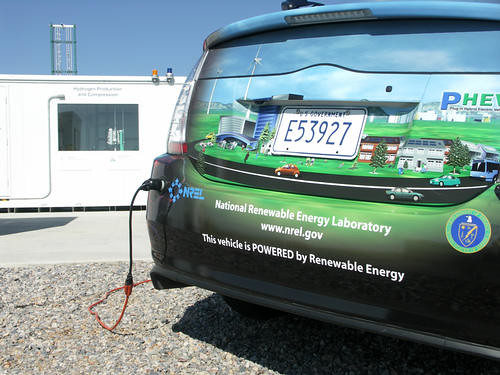
A real break with the past requires electric cars, eventually powered by zero-carbon hydrogen. That’s several years in the future – maybe a decade. But electric cars, the plug-in variety with batteries you plug in at night, will start hitting the road very soon (a few are already there.) And when they do, you can bet competition will heat up. It’s already simmering.
Two leaders are Israel and, yes, China.
Israel said last week it will support a large-scale project to put electric cars on the road as early as next year. An Israeli-American entrepreneur, Shai Agassi, is working with Renault/Nissan to test such a car (and supporting infrastructure) in the tiny country, where gasoline costs more than $6 a gallon. He sees small European countries like Denmark, where gas taxes are high, as ideal places to market the cars. Small is good, because these cars can run some distance on electricity alone, before they need recharging or a gasoline engine to kick in.
The Israeli cars will be able to go 124 miles on a charge. Usually the batteries will be recharged at home at night, when electricity is cheapest. But service stations will be able to recharge or change out the batteries. The cars – from Renault and Nissan – will be subsidized, with a monthly fee for service. Operating costs are expected to be half that of a gasoline-powered car.
The prediction is that several thousand will be on the road next year, with 100,000 by the end of 2010. (In Israel, about 10% of the cars are replaced each year.)
The company sees this concept as a money-maker and is eyeing the Chinese market as well. Chinese auto company Chery apparently is interested.
China has plans of its ownShanghai, which may well become the Detroit of the 21st century, has a program to experiment with a variety of clean technologies, according to “Zoom: The Global Race to Fuel the Car of the Future,” a new book by Iain Carson and Vijay Vaitheeswaran.
Gang Wan, head of the program, had worked at Audi and decided it didn’t make sense to try to catch up with foreigners’ head start on the combustion engine. Instead he is looking at electric, hybrid gasoline/diesel-electric, compressed natural gas and hydrogen fuel cells to power automobiles.
Hoping to have 1,000 clean cars and buses on the streets of Beijing for the Olympics, the project’s longer-range goal is for mass production of hydrogen fuel-cell cars by 2020. General Motors has signed on to help with both the fuel cells and the filling stations that will be needed.
China has many advantages in producing fuel cell technology, according to “Zoom.”
• It doesn't have the extensive investment in internal-combustion engines or the infrastructure of gas stations the West does, so there will be little resistance.
• Its giant dams produce enough excess hydropower to fuel 37 million cars by 2010 and 56 million by 2020.
• The potential market in China alone is huge.
• The government can mandate the changes.
Maybe you’ll drive one of theseMost auto companies have a plug-in in the works. A few will be ready in the next year or two. Here are a some examples:
• Chevrolet’s Volt is scheduled for a 2010 launch. GM will road-test it this year. The plug-in Volt goes 40 miles on a battery charge, with a gasoline engine as back-up.
• Toyoto says it too will build a plug-in hybrid by 2010, for use by governments and corporations. The general public will have to wait a bit longer. And Toyota is testing a fuel-cell car, which has traveled 350 miles on a tank in Japan. A newer version can go 466 miles, the company said.
• Fisker Automotive’s plug-in Karma is an $80,000 luxury car, which goes 50 miles before a small gasoline engine generates electricity to recharge it. Fisker says Karma is ready to be mass produced.
• Italy’s Pininfarina, aims for a 2009 launch of its small 4-seater electric car. It goes 155 miles before recharging and the company says it could produce up to 15,000 a year if the demand is there.
• Tata Motors in India is partnering with Chrysler to make an electric version of its mini-truck, Ace, for sale in the U.S. Tata is working with other foreign partners on hybrids and fuel cells. (Tata is the car-maker that just released a $2,500 car in India, putting car ownership within reach for millions.)
• Subaru’s G4e (Good4Earth) is a plug-in electric commuting car and can go 124 miles on an overnight charge. Quick-chargers, located at supermarkets and other public places, will give an 80% charge in 15 minutes. If the car is plugged in at night, the energy per mile could be 1/10th that of gasoline fueled cars.
• AFS Trinity has the Extreme Hybrid, a retrofitted Saturn Vue, which can go 40 miles on electricity and then on gas.
• General Motors is test-driving its Equinox fuel-cell cars in 3 cities. The car probably won’t reach mass production for 10 years, GM says.
Cutting GHG emissionsSwitching to plug-ins could do a lot to help the environment. The Electric Power Research Institute and Natural Resources Defense Council say mass use of plug-in hybrids could cut greenhouse gases by more than 450 metric tons a year by 2050, the same as removing 82.5 million cars from the road.
But Honda CEO Takeo Fukui predicts the future for the auto industry is in fuel cells, which produce no carbon. He sees the plug-in hybrid as a battery-powered car with an unnecessary fuel engine and tank.
Fuel cells, which use hydrogen and oxygen to generate electric power, are 2-3 times more efficient than the internal combustion engine, according to the Society of Automotive Engineers. They have no moving parts and the only byproducts are heat and water. Of course, with new technologies, new companies can horn in on the majors' act.
And infrastructure is no small matter in the United States. About 12,000 of the country’s 170,000 filling stations will have to be converted to serve up hydrogen, GM says. No doubt there will be a lot of resistance.
For more on green autos, check out
greenauto blog. (Sources: “Zoom,” New York Times, E&E Daily, Greenwire, PlanetArk, AOL Auto, Chicago Sun-Times, Salon.com.
(Picture courtesy of Flickr and
ourgreencommunity.org)
P.S. Debates silent on global warmingYou may have noticed there have been virtually no questions about global warming in the presidential debates. The League of Conservation Voters and Sierra Club helped end the drought with petitions from 200,000 of us. Tim Russert asked the first climate change question in the last debate. In fact he asked two. Now it’s time to call CNN and tell Wolf Blitzer to ask about global warming in this Thursday’s debate. Call (404)827-1700.