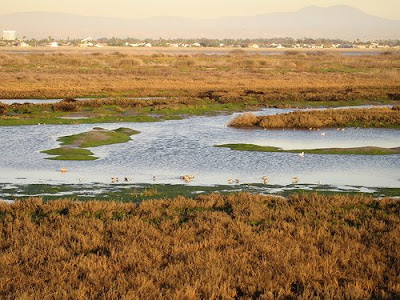
 (Photo of Bolsa Chica wetlands restoration in California from Flickr and and photographer Mollivan Jon)Weekly Angst:
 Add wetlands to the list if things that can cause global warming. Swamps and marshes are great carbon sinks, storing about 20% of the carbon and methane on the Earth’s land surface.
But as wetlands dry up from climate change, or are drained for development or agriculture, those greenhouse gases have the potential to do as much damage as industrial emissions. This was a topic of discussion and concern for 700 experts from 28 countries who met at last week’s 8th International Wetlands Conference in Brazil.
Wetlands hold some 770 billion metric tons of greenhouse gases, equal to what's now in the atmosphere. And emissions from wetland have the potential to negate all other steps to stop global warming if we don’t act to preserve these places so essential to the planet’s health.
Bad imageWetlands get little respect. They have long been seen as useless and yucky, interfering with development, farming and other civilized things. So about 60% of wetlands across the world have been destroyed in the last century. Europe drained 90% of its wetlands for farming, the U.S. has drained more than half of its, and the California coastal region destroyed about 95%.
We know wetlands serve as a habitat for wildlife. We also know that in coastal areas they can buffer against hurricanes. We learned that when Katrina devastated New Orleans. If only the wetlands had been left in place, the impact of the storm wouldn’t have been as great.
Wetlands serve as natural “horizontal levees,” that can prevent flooding by storing floodwater. The recent floods in the Midwest reminded scientists that the Mississippi River once could store 60 days of floodwater in its wetlands, where now it can only store 12 days’ worth.
Wetlands – which include marshes, swamps, river deltas, peat bogs, mangroves and river flood plains – produce 25% of the world’s food, purify water and recharge aquifers.
Some thawing of the Arctic wetlands permafrost is probably inevitable at this point, so efforts to stop draining wetlands in more temperate and tropical climates is essential – not to mention restoration.
RestorationSome restoration projects are under way – in the Everglades and on the Louisiana coast, with each one costing upwards of $5 billion. But it’s much cheaper to preserve the existing wetlands than have to rebuild them, scientists remind us.
In Southern California, the recently restored Bolsa Chica wetlands are now bursting with birds and fish. The project cost $147 million and culminated 40 years of struggle between environmentalists and developers. Part of the problem was a duck blind constructed by hunters. Now the wetlands connect to the Pacific Ocean basin, as they should.
(Sources: ClimateWire, Greenwire,
Reuters )


